

10 March 2026
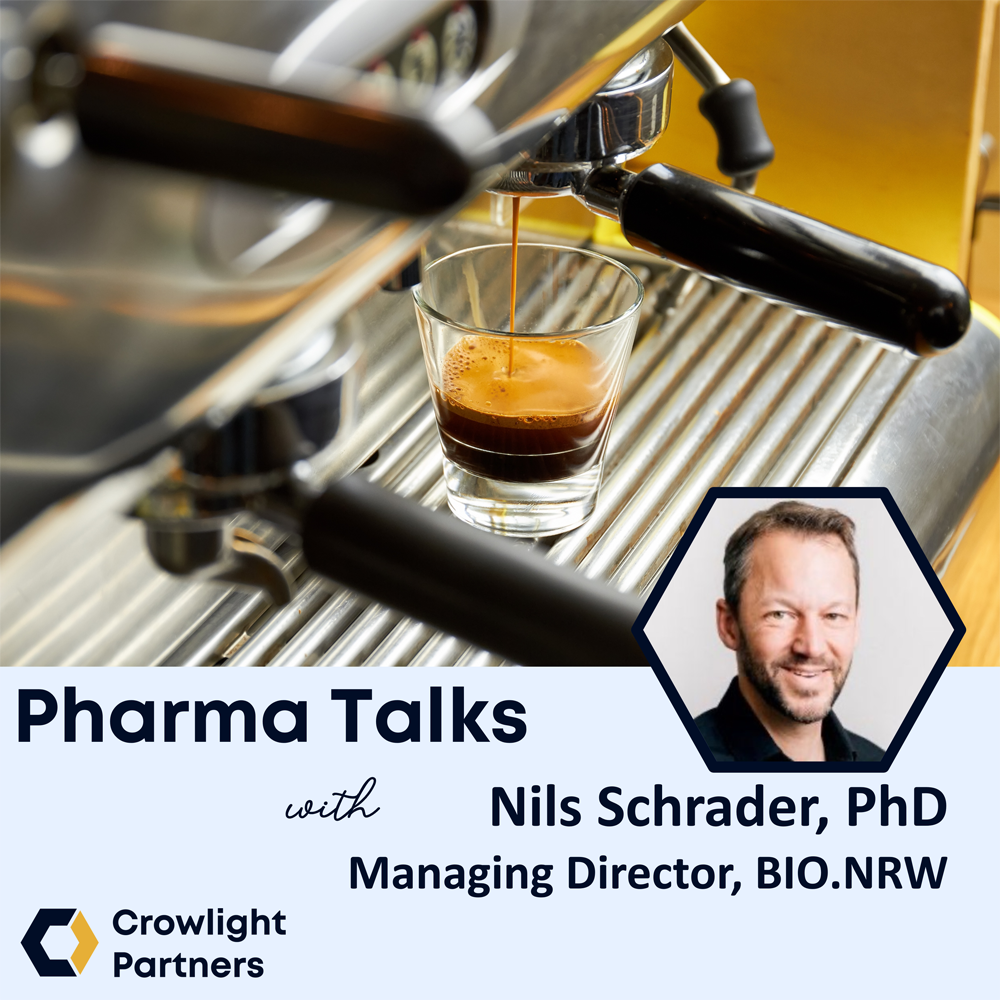
After studying Biotechnology at the TU Braunschweig followed by a research stay at the University hospital of Ulm, work for his PhD in biochemistry has been mainly conducted at the State University of New York at Stony Brook and Brookhaven National Laboratory, New York, USA. Following a postdoctoral stay at the structural biology group of the Max-Planck-Institute in Dortmund, Nils Schrader joined BIO.NRW – The Home of Biotech in 2009 as scientific project manager. In 2018, he became Managing Director of the BIO.NRW network in Düsseldorf. Today, BIO.NRW is the official umbrella organization of the federal state of North Rhine-Westphalia with a strong focus on pharmaceutical biotechnology and biomedicine including adjacent areas of life sciences. Nils Schrader is member of several jurys for awards and programs of public funding as well as member of the board of advisors of MedLife Aachen e.V.
Question:
BIO.NRW sits at the intersection of science, start-ups, industry and policy. In your view, what is still underestimated when it comes to translating excellent science into sustainable biotech companies?
Answer:
For me, this question has two dimensions. First, what does it actually take to make translation successful? And second, how do we define sustainable success?
What we consistently take away from many conversations and experiences is that it starts with the right people. The team is absolutely critical. That is something we hear from investors again and again. Then you need the right infrastructure. And today, infrastructure does not just mean lab space or bench space. It means comprehensive support across all relevant areas, such as HR, IP protection, administration, legal matters, funding, and operational guidance.
The third point is capital. Without money, nothing happens.
The interesting part is the word “sustainable.” Founding a company and developing it to an exit is the normal life cycle of many biotech companies. From a technology perspective, that may be sustainable, because the innovation is absorbed into larger structures and taken forward there. But from the perspective of a region like NRW, that is not yet the kind of sustainable development we would like to see.
We would like to see more companies that continue to grow locally, raise additional financing rounds, build broader pipelines, and develop beyond an early exit. That is much rarer and for that, many factors need to come together.
And one thing should never be forgotten: in pharma, development risk always remains. If something goes wrong in Phase 2, a company can very quickly reach its limits. Those inherent risks can never be fully eliminated, and they always stand in the way of truly sustainable biotech development to some extent.
System Friction
Question:
Where do you currently see the biggest systemic friction points that slow down the translation of research into internationally competitive biotech companies?
Answer:
In Germany — and also in NRW — we clearly have challenging framework conditions, especially on the regulatory and administrative side. The whole area of approvals, permits, and interactions with authorities is a real problem. In some individual cases, it is even existential, including for larger companies. That is an area where we clearly have work to do.
The second major point is capital. Compared with the US, there is significantly less money in the market, on a completely different scale. We can partly compensate for that through strong science, or by pushing development somewhat further within academia, but fundamentally it remains a structural disadvantage.
In the seed and pre-seed space, we have fewer problems today than in the past. There are good examples of strong early-stage financings. But those are still more the exception than the rule. Overall, capital availability remains a limiting factor.
Global Positioning
Question:
If you compare NRW with international hubs such as Boston, Cambridge or Basel: where do you see an underestimated structural strength and where do you see a weakness we still have not addressed sufficiently?
Answer:
A clear strength of NRW is its diversity. If you look at NRW as a whole, structurally we are not as far away from established clusters as people sometimes assume. The bigger issue is that NRW is not perceived as one clearly visible, concentrated location.
We have the densest higher-education network in Europe, with around 70 universities and universities of applied sciences. That is a tremendous asset. We have strong locations across many disciplines: MedTech and engineering in Aachen, strong cancer research, gerontology in Cologne, and overall a very broad scientific base. That diversity is a real advantage.
The weakness is that this strength is not sufficiently visible. We are not concentrated in one place in the same way Basel or Cambridge are. That makes perception, branding, and international positioning more difficult. On top of that, we have less capital in the market and no comparable Big Pharma anchor like Basel.
Perhaps a certain reluctance around risk is part of it as well. When resources are more limited, people tend to focus more on de-risking. That is understandable, but at some point, you also have to be willing to take calculated risks if you want to compete internationally.
Valley of Value
Question:
Many companies survive the early phase, but struggle to build sustainable value. In your experience, where does the German biotech system lose the most value and why?
Answer:
I strongly agree that the core problem today is no longer the very early stage. Pre-seed and seed are functioning much better than they used to. The major challenge begins with follow-on financing.
If a company is to be built in a truly sustainable way, it often needs much larger financing rounds, not just five or ten million, but potentially fifty or eighty million. That is exactly where things become difficult.
The problem has actually become more severe in recent years because pharmaceutical companies have become more risk-averse. Partnerships and acquisitions happen later. Pharma wants to see more data before making larger decisions. The consequence is that biotech companies have to keep developing longer on their own and that additional development runway requires time, people, and capital.
A good example is the changing value-creation logic in early pharma. In the past, certain programs could be licensed or sold much earlier. Today, that is often no longer enough. More data, more structure, and more team building are required. That means new companies have to be created to carry out that development work in the first place. This is exactly where value is lost if capital, resources, and time are insufficient.
And then there is bureaucracy. Regulatory requirements and administrative burdens consume resources and slow progress. That, too, ultimately destroys value.
Pharma–Startup Interface
Question:
Large pharmaceutical companies often say they want to work with start-ups earlier. In your view, what do start-ups most often misunderstand about pharma and what does pharma underestimate about early biotech companies?
Answer:
One important issue is that start-ups often do not know the right contacts or decision-making pathways inside large pharmaceutical organizations. Especially in the beginning, there is often a certain hesitation to approach pharma at all. People do not know whom to speak to, whether there is any interest, or how these organizations actually work and everything can appear very closed and highly proprietary.
That is exactly why clusters and exchange platforms are so important. They create the conditions for contacts to emerge, and they help founders understand how pharma thinks, what pharma is looking for, and how collaboration can actually be initiated. Without such structures, that bridge is often missing.
At the same time, start-ups often worry that if they engage too early, their IP or USP may be diluted or absorbed. That concern is understandable. Which is why formats that build trust and mutual understanding are so important.
Programs such as JLABS or similar initiatives from larger companies can help lower exactly these barriers. Such formats create exchange, facilitate access, and encourage a much better understanding on both sides. In successful clusters such as Basel, you can clearly see how important these structured spaces for interaction are.
Policy vs. Execution
Question:
Germany has many programs, grants and initiatives. If you could change one policy lever tomorrow to improve execution speed in biotech, what would it be?
Answer:
I would especially like to see more funding in later technology readiness level (TRL) stages, meaning larger ticket sizes, larger funding volumes, and not just many small projects. For pharma and biotech in particular, this is crucial, because capital requirements are shifting further downstream as partnerships happen later.
If pharma comes in later and follow-on financing is missing at the same time, then in principle public funding could help close part of that gap. But those instruments are largely missing, or only available in very selective cases.
We have seen some individual programs with larger volumes, but mostly in very specific structural funding contexts. If there were a strategic will to do so, one could create stronger, more selective programs that move the most promising companies forward more quickly with meaningful funding volumes. From my perspective, that would be a very important lever.
Talent & Leadership
Question:
Scientific excellence is there, but experienced biotech leadership is still scarce. How critical is operational and strategic maturity compared with science and how can clusters like BIO.NRW help close that gap?
Answer:
It is essential. Science alone is not enough. Experienced leadership, operational maturity, and strong decision-making capability are absolutely central.
What we can do — and what we are already doing — is provide support through coaches, mentors, and experienced sparring partners. Programs like GeneNovate show how important those structures are.
What matters, however, is a systemic approach: start-ups should, if they want it, have early access to professional support tailored to their individual stage and needs. That can range from time-limited coaching to more intensive hands-on support. Fundamentally, we need these support structures on a permanent basis.
Founder Mindset
Question:
If you could give founders in NRW one uncomfortable message early on, what should they stop doing, even if it feels scientifically right?
Answer:
Founders need to become more focused. They need to think much more from the product side and from the path to the product, not only from the scientific idea.
A common mistake is to get lost in maximum market potential, global opportunity narratives, or a large number of possible applications. But what investors want to understand is this: what is the actual product? How do you get there? And where can you create real traction or cash-flow relevance first?
Trying to address everything at once does not work. Focus is critical.
Closing Question
Question:
If you look five to ten years ahead: what would real success for BIO.NRW look like, not in KPIs or funding volumes, but in outcomes that truly matter for patients, companies and the ecosystem?
Answer:
For me, real success would mean a vibrant, broad biomedical pipeline coming out of NRW, with meaningful developments in areas such as ATMPs, cancer, Alzheimer’s and other biopharmaceutical fields and above all successful commercializations that originate here and actually reach patients.
It is not about limiting that vision to individual indications. What matters is that we see a number of real success stories: programs and companies that advance clinically and commercially, become visible beyond the region, and create momentum for the ecosystem as a whole.
Of course, the benefit to patients is always the ultimate goal. But such success stories are also critical in making NRW visible as a strong biotech location. And I am optimistic that in five to ten years, we will see significantly more examples of that kind.