🤝Trust is regularly overestimated in negotiations. And regularly underestimated. Often by the same people.
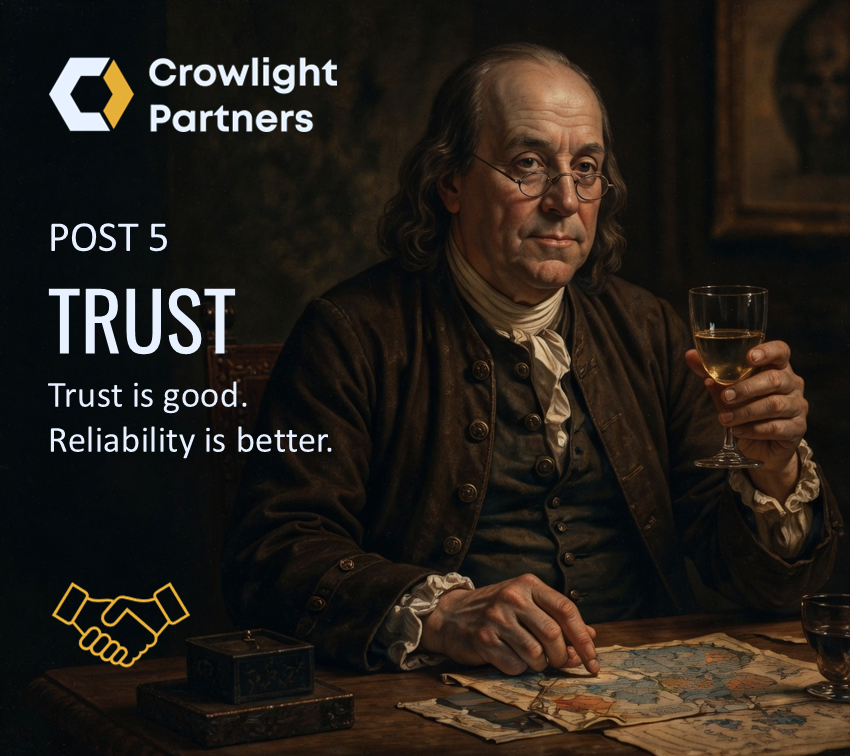
Benjamin Franklin looks around the table.
“Trust is a strange thing. Nobody wants to be the first to give it—yet everyone expects it from the other side.”
Machiavelli nods.
“Because trust can be costly.”
“Distrust can be too,” Franklin replies.
At this moment, there is no immediate objection.
That is what makes the discussion dangerous.
Many negotiators treat trust as a moral category. A question of character.
But trust has an economic effect.
It accelerates decisions. Reduces controls. Simplifies coordination. Expands room for action.
Distrust does the opposite.
“Business is done between people,” Franklin says.
“Business is done between interests,” Machiavelli replies.
Franklin smiles.
“Then explain why some people do business with each other for decades!”
Machiavelli falls silent.
Longer than usual.
“Because their interests remain compatible over decades.”
Socrates grins.
“That was surprisingly close to agreement.”
Thomas More, who has been listening quietly until now, speaks up.
“I know people who have worked together for decades—not because their interests are identical, but because they have never disappointed each other. That is not calculation. That is character.”
Machiavelli studies him intently.
“Character,” he says, “is the most expensive way to reach the same outcome.”
“And the most durable,” Thomas More replies calmly.
Maimonides joins the conversation. The others are increasingly uneasy when he speaks.
“Trust is not created by intentions,” he says.
“But by predictability.”
The sentence hangs in the air.
In complex negotiations, the decisive question is rarely: Do we trust each other?
It is: What exactly can we rely on?
The difference seems small. It is anything but.
The best negotiators do not replace trust with contracts. Nor do they replace contracts with trust.
They understand the function of both.
What is trust to you: the starting point, without which nothing begins? Or the result of lived consistency?
Deutsche Version:
Vertrauen
🤝Vertrauen wird in Verhandlungen regelmäßig überschätzt. Und regelmäßig unterschätzt. Beides oft von denselben Menschen.
Benjamin Franklin schaut in die Runde. „Vertrauen ist eine merkwürdige Sache. Niemand möchte der erste sein, der es schenkt – aber jeder erwartet es vom anderen.”
Machiavelli nickt. „Weil Vertrauen teuer werden kann.”
„Misstrauen auch”, antwortet Franklin.
In diesem Moment entsteht nicht sofort Widerspruch. Das macht die Diskussion gefährlich.
Viele Verhandler behandeln Vertrauen wie eine moralische Kategorie. Als Frage des Charakters.
Vertrauen hat einen wirtschaftlichen Effekt. Es beschleunigt Entscheidungen. Reduziert Kontrollen. Vereinfacht Abstimmungen. Erhöht Handlungsspielräume. Misstrauen bewirkt das Gegenteil.
„Geschäfte werden zwischen Menschen gemacht”, sagt Franklin.
„Geschäfte werden zwischen Interessen gemacht”, antwortet Machiavelli.
Franklin lächelt: „Dann erklär mir, warum manche Menschen über Jahrzehnte miteinander Geschäfte machen!”
Machiavelli schweigt kurz. Länger als gewöhnlich. „Weil ihre Interessen über Jahrzehnte kompatibel bleiben.”
Sokrates grinst: „War das überraschend nah an einer Zustimmung?”
Thomas Morus, der bisher ruhig zugehört hat, meldet sich zu Wort: „Ich kenne Menschen, die seit Jahrzehnten miteinander arbeiten – nicht weil ihre Interessen deckungsgleich sind, sondern weil sie einander nie enttäuscht haben. Das ist kein Kalkül. Das ist Charakter.”
Machiavelli betrachtet ihn eindringlich. „Charakter”, sagt er dann, „ist der teuerste Weg zum selben Ergebnis.” „Und der haltbarste”, antwortet Morus ruhig.
Maimonides meldet sich zu Wort. Die anderen macht das zunehmend nervös: „Vertrauen entsteht nicht durch Absichten”, sagt er. „Sondern durch Vorhersagbarkeit.”
Der Satz bleibt im Raum hängen.
In komplexen Verhandlungen lautet die entscheidende Frage selten: Vertrauen wir einander? Sondern: Worauf genau können wir uns verlassen?
Der Unterschied wirkt klein. Doch das Gegenteil ist der Fall.
Die besten Verhandler ersetzen Vertrauen nicht durch Verträge. Und Verträge nicht durch Vertrauen. Sie verstehen die Funktion beider.
👉 Was ist Vertrauen für Sie: die Basis, ohne die man nicht anfangen kann? Oder das Ergebnis von gelebter Konsistenz?