What do a real estate broker in Hamburg, a researcher at Kühne Logistics University, and a founder in Singapore have in common?
They all negotiate every day. Then again, most of us probably do. But what connects these three is that none of them thinks in terms of individual deals.
🔹 Rohit Jha, CEO of Transcelestial, Singapore: “I put all the features and prices on the table and hand the other party a pen. Cross out what you don’t need.” If they want less, they have to say what they are willing to give up. An elegant reversal of conventional negotiation logic — and an effective way to build trust.
🔹 Niels van Quaquebeke, Professor of Leadership at Kühne Logistics University in Hamburg: “I have learned that thinking beyond a single negotiation is more important than the short-term gain.”
🔹 Ulf von der Heydt, Managing Director of BHI Hamburg: “Good negotiations have one thing in common: clarity and openness. When those are present, everything can move quickly and smoothly.”
What connects the three is that none of them optimizes for the moment.
Jha turns trust into a method by framing discussions around value. Van Quaquebeke describes it as the compound-interest effect of social capital — relationships that shorten the path to agreement the next time around. And von der Heydt adds a dimension that is often overlooked: sometimes the best outcome emerges when the intermediary consciously steps back and allows the parties to come together without him.
Good negotiations do not end with an agreement. They lay the foundation for the next one.
+++ Deutsche Version +++ German version +++
Was haben ein Immobilienmakler in Hamburg, ein Wissenschaftler an der Kühne Logistics University und ein Gründer in Singapur gemeinsam?
Sie alle verhandeln täglich. Nun ja, das tun wir vermutlich alle. Doch was diese drei verbindet: Keiner von ihnen denkt in Einzelabschlüssen.
🔹 Rohit Jha, CEO von Transcelestial, Singapur: “Ich lege alle Features und Preise auf den Tisch und gebe dem Gegenüber einen Stift. Streiche, was du nicht brauchst.” Wer weniger will, muss sagen, worauf er verzichtet. Eine elegante Umkehrung der Verhandlungslogik — und ein wirksamer Weg, Vertrauen herzustellen.
🔹 Niels van Quaquebeke, Professor für Leadership an der KLU Hamburg: “Ich habe gelernt, dass langfristiges Denken über die einzelne Verhandlung hinaus wichtiger ist als der kurzfristige Gewinn.”
🔹 Ulf von der Heydt, Geschäftsführer von BHI Hamburg: “Gute Verhandlungen haben etwas gemeinsam: Klarheit und Offenheit. Dann kann alles schnell und unkompliziert ablaufen.”
Was die drei verbindet: Keiner von ihnen optimiert für den Moment.
Jha macht Vertrauen zur Methode, indem er wertbasiert argumentiert. Van Quaquebeke nennt es den Zinseszins-Effekt im Sozialkapital — Beziehungen, die beim nächsten Mal den Weg zum Abschluss abkürzen. Und von der Heydt fügt eine oft übersehene Dimension hinzu: Manchmal entsteht das beste Ergebnis, wenn man als Vermittler bewusst einen Schritt zurücktritt — und die Parteien ohne einen selbst zusammenkommen lässt.
Gute Verhandlungen sind mit einem Abschluss nicht zu Ende. Sie legen den Grundstein für den nächsten.
Was wäre, wenn die klügsten Köpfe der Menschheitsgeschichte gemeinsam am Verhandlungstisch säßen? Und wenn sie sich streiten? Um so besser. Also stellen wir uns vor: Ein Konferenzraum irgendwo zwischen den Jahrhunderten.
Acht Männer sitzen an einem Tisch. Verhandlungsprofis. Wer ist dabei? Und was charakterisiert einen jeden?
Konfuzius(ca. 551–479 v. Chr., Staat Lu, heute Provinz Shandong, China) achtet auf Beziehungen.
Augustus(63 v. Chr.–14 n. Chr., Rom, Italien) sieht Macht als zentralen Faktor. Thomas Morus(1478-1535, London, England) betrachtet sich als Humanisten.
Sun Tzu(vermutlich 544–496 v. Chr., Staat Qi, China) bereitet sich akribisch vor: Er hat den Raum bereits analysiert, bevor er ihn betreten hat.
Benjamin Franklin(1706–1790, Boston, Massachusetts, USA) blickt auf Koalitionen. Jeden am Tisch kennt er – und arbeitet bereits daran, zwei von ihnen zu verbünden.
Maimonides(1138–1204, Córdoba, Al-Andalus, heute Spanien) denkt in Integrität.
Niccolò Machiavelli(1469–1527, Florenz, Italien) verfolgt zuallererst seine eigenen Interessen.
Und Sokrates(ca. 470–399 v. Chr., Athen, Griechenland) glaubt, dass die meisten Menschen schlicht die falschen Fragen stellen.
„Was ist eine gute Verhandlung?” fragt er in die Runde.
Machiavelli antwortet sofort. „Eine, die man gewinnt.”
Konfuzius schüttelt den Kopf. „Eine, nach der man weiter zusammenarbeiten kann.”
Augustus lächelt. „Eine, nach der die Machtverhältnisse günstiger sind als zuvor.”
Franklin greift zum Wein. Ein Abend wie dieser braucht Vorbereitung.
Sun Tzu sagt nichts. Er beobachtet. Das allein macht ihn zur gefährlichsten Person im Raum.
„Interessant”, sagt Sokrates. „Unterschiedliche Antworten. Keine Definition.”
In komplexen Verhandlungen erleben wir immer wieder denselben Fehler: Die Beteiligten diskutieren über Preise, Verträge oder Fristen. Tatsächlich verfolgen sie völlig unterschiedliche Ziele.
Für den einen zählt Geschwindigkeit. Für den anderen Kontrolle. Für den Dritten die Beziehung. Für den Vierten das Ergebnis.
Wer die unterschiedlichen Erfolgsdefinitionen nicht erkennt, verhandelt über Symptome. Nicht über Interessen.
„Vielleicht”, sagt Sokrates nach einer längeren Pause, „beginnen schlechte Verhandlungen dort, wo alle glauben, über dasselbe zu sprechen.”
Zum ersten Mal wird es still. Sogar Machiavelli schaut auf.
In den kommenden Wochen diskutieren diese sieben Männer über Macht, Vertrauen, Information, Druck, Koalitionen und Integrität. Einig werden sie sich selten. Und genau deshalb lohnt es sich zuzuhören.
👉 Welche Figur hätten Sie lieber auf Ihrer Seite des Tisches?
Anyone advocating for better conditions for the pharmaceutical industry—whether trade associations, company representatives, investors, or politicians—eventually reaches for the same argument:
“Hundreds of thousands of jobs depend directly and indirectly on this industry.”
And therefore, the argument goes, policymakers cannot ignore it.
They can. And they should.
Not because the numbers are wrong. They may well be accurate. The problem is that they measure the wrong thing.
The Argument Defeats Itself
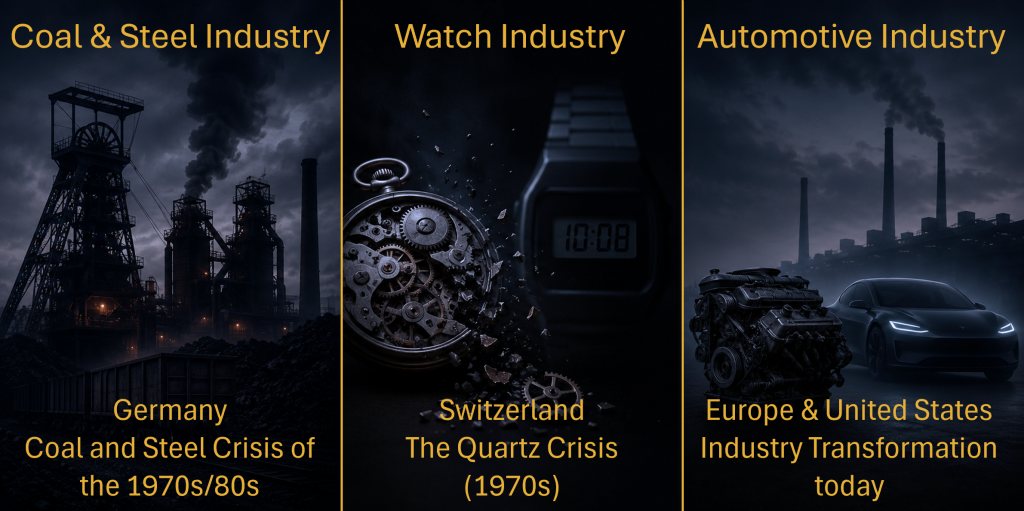
Using employment as a justification for reimbursement policy, industrial policy, or market access decisions is a strategy more commonly associated with industries in decline.
Germany’s coal and steel sector relied on it. The Swiss watch industry did so during the quartz crisis of the 1970s. Parts of the automotive sector continue to use it today—with diminishing success.
The implicit message is always the same:
We are too large to change. Protect us.
The problem is that structural change rarely negotiates with employment statistics. Societies that allowed industries to adapt—sometimes slowly, sometimes painfully—have generally emerged stronger than those that tried to preserve existing structures indefinitely.
The jobs argument therefore does not defend the pharmaceutical industry’s societal value. Instead, it unintentionally suggests that more compelling arguments may be unavailable.
For a sector as important as pharmaceuticals, that is an own goal.
A Strong Industry Making a Weak Argument
Pharmaceuticals are not a declining industry. They are among the most research-intensive, capital-intensive, and socially consequential sectors in the global economy.
Between 1990 and 2015, roughly one-third of the global increase in life expectancy has been attributed to pharmaceutical innovation. The industry invests more than $240 billion annually in research and development, making it one of the world’s largest investors in innovation.
Reducing that contribution to a discussion about jobs means abandoning the strongest argument available.
Worse still, the employment narrative invites an uncomfortable counterargument:
Would society be better off if those jobs were allocated elsewhere?
The moment employment becomes the primary justification, that question becomes legitimate.
Defending innovation is a far stronger position than defending employment for its own sake.
The Debate We Should Be Having
The pharmaceutical industry possesses substantial arguments. They simply receive far less attention than they deserve.
Consider innovation.
A new therapy often enters public debate only when its budget impact becomes visible. Yet medicines that reduce hospitalisations, delay dependency, avoid rehabilitation costs, or improve productivity frequently create value far beyond the healthcare budget line item where they are assessed.
Both dominant health technology assessment frameworks share a similar structural blind spot.
QALY-based approaches, used in countries such as the United Kingdom, Sweden, Norway, Denmark, and the Netherlands, attempt to capture gains in quality and length of life. Yet broader societal benefits often remain outside the analysis.
Meanwhile, comparative clinical-benefit frameworks such as those used by Germany’s IQWiG or France’s HAS focus on incremental clinical benefit relative to standard of care. They measure relative clinical value, but not necessarily total societal value.
Productivity gains, caregiver relief, reduced social expenditure, and avoided downstream costs frequently remain invisible under both approaches.
This is not merely a technical limitation. It is a structural valuation problem—and one that deserves a far more open debate.
The evolution of NICE’s cost-effectiveness threshold illustrates the point. For more than two decades, from 1999 to 2025, the benchmark remained largely unchanged at approximately £20,000 per QALY. Adjusted for inflation, the figure would have been close to £30,000 by the end of that period. In real terms, the threshold had been quietly tightening for years before NICE finally revised it upward in late 2025.
The adjustment acknowledged the pressure. It also revealed how long that pressure had been ignored.
International reference pricing presents another example.
The system effectively penalises transparency. Countries that disclose negotiated prices often receive less favourable terms, while manufacturers delay launches in lower-price markets to avoid creating downward pressure elsewhere.
Germany has long served as a prominent example of this dynamic.
This is not merely a pharmaceutical problem. It is a structural flaw in the way many international pricing systems interact with one another. It deserves a serious policy discussion, and the industry could play a constructive role in shaping solutions rather than merely reacting to them.
Supply-chain resilience provides another case.
The issue is frequently framed as one of preserving jobs. In reality, it is a question of strategic security.
As active pharmaceutical ingredient production becomes increasingly concentrated in Asia, healthcare systems become more vulnerable to geopolitical tensions, manufacturing disruptions, and quality failures.
The relevant question is not whether jobs remain in a particular country.
The question is whether societies are comfortable with critical dependencies in areas directly linked to public health.
That is an argument about resilience, not employment.
Incentives Matter on Both Sides
The pharmaceutical industry is not the only actor operating within imperfect incentives.
Generic penetration rates in many European markets remain well below the roughly 90 percent levels achieved in the United States. As a result, healthcare systems often continue paying more than necessary for medicines whose patent protection expired long ago.
Those resources could potentially be redirected toward innovation.
At the same time, pharmaceutical companies face distortions of their own.
In Switzerland, for example, reimbursement negotiations that are formally expected to conclude within sixty days often take a year or longer. When effective market access delays consume a meaningful portion of a patent’s commercial life, pricing behaviour inevitably adjusts.
This does not justify every pricing decision.
But it does illustrate a broader point.
Constructive debate requires acknowledging structural distortions on all sides. The goal should not be to assign blame. It should be to design incentives and institutions that reduce the need for defensive behaviour in the first place.
A Question of Values and Systems
Once the discussion shifts away from employment and toward value, access, incentives, and sustainability, a deeper reality emerges.
The fundamental disagreements are not technical.
They are societal.
Questions such as:
How should limited healthcare resources be allocated?Should systems prioritise broad access to inexpensive treatments or fewer breakthrough innovations that prevent future costs?
What about externalized effects — who gets to benefit or carry the burden? A drug that renders hospital stays unnecessary relieves one budget but burdens another; this transfer remains invisible during price negotiations.
Where does individual responsibility end and collective responsibility begin? How should societies think about conditions influenced by lifestyle choices?
None of these questions has a universally correct answer. They reflect societal priorities and value judgments.
Yet these debates are often displaced by power dynamics. The stakeholder with the strongest leverage frequently defines the framework within which discussions occur.
That is the real problem. Not the number of jobs.
Patient organisations, HTA agencies, pharmaceutical companies, physicians, health economists, hospitals, payers, and biotech investors all bring different perspectives to these questions.
The fact that many of these perspectives remain marginal in public discussions about pharmaceutical policy is symptomatic of a debate that too often confuses bargaining power with analytical rigor.
Neither a Zero-Sum Game Nor a Simple Equation
The pharmaceutical industry operates within a genuine structural dilemma.
Patent protection creates temporary monopolies in order to incentivise innovation.
Reimbursement systems were largely designed for blockbuster medicines, not for orphan drugs, preventive therapies, or antibiotics.
Payers face democratic budget pressures and frequently employ tactics that many private-sector negotiators would consider problematic.
These tensions are real. They require real answers. Employment statistics do not provide them. They trigger political reflexes while distracting attention from the substantive questions that matter most.
Could higher pharmaceutical spending reduce overall healthcare expenditure by preventing hospitalisations and costly downstream interventions?
Are intermediary structures in the U.S. healthcare system—such as pharmacy benefit managers and vertically integrated insurance groups—capturing value that never reaches patients?
Should international pricing mechanisms implicitly reward dysfunctional market structures elsewhere?
Are regulatory delays shortening effective patent life to a degree that undermines investment incentives?
These are difficult questions. They cannot be reduced to slogans, and they do not fit neatly into press releases. But they belong at the centre of public debate.
A Better Way Forward
The pharmaceutical industry should stop defending itself primarily through employment statistics. Instead, it should quantify societal value more comprehensively—capturing both positive and negative externalities across the healthcare system.
It should not only justify its own prices. It should also highlight sources of value destruction elsewhere in the system: inefficient intermediaries, excessive administrative complexity, and actors that extract economic value without creating corresponding clinical value.
It should not fight HTA frameworks as such. It should help improve them. And it should move beyond defending list prices toward developing pricing models that share uncertainty rather than transferring it entirely to one side. Outcome-based reimbursement is not a concession. It is an invitation to genuine partnership.
The pharmaceutical industry has no shortage of strong arguments. Employment simply is not the strongest one.
Let’s stop talking about jobs. Let’s talk about value.