


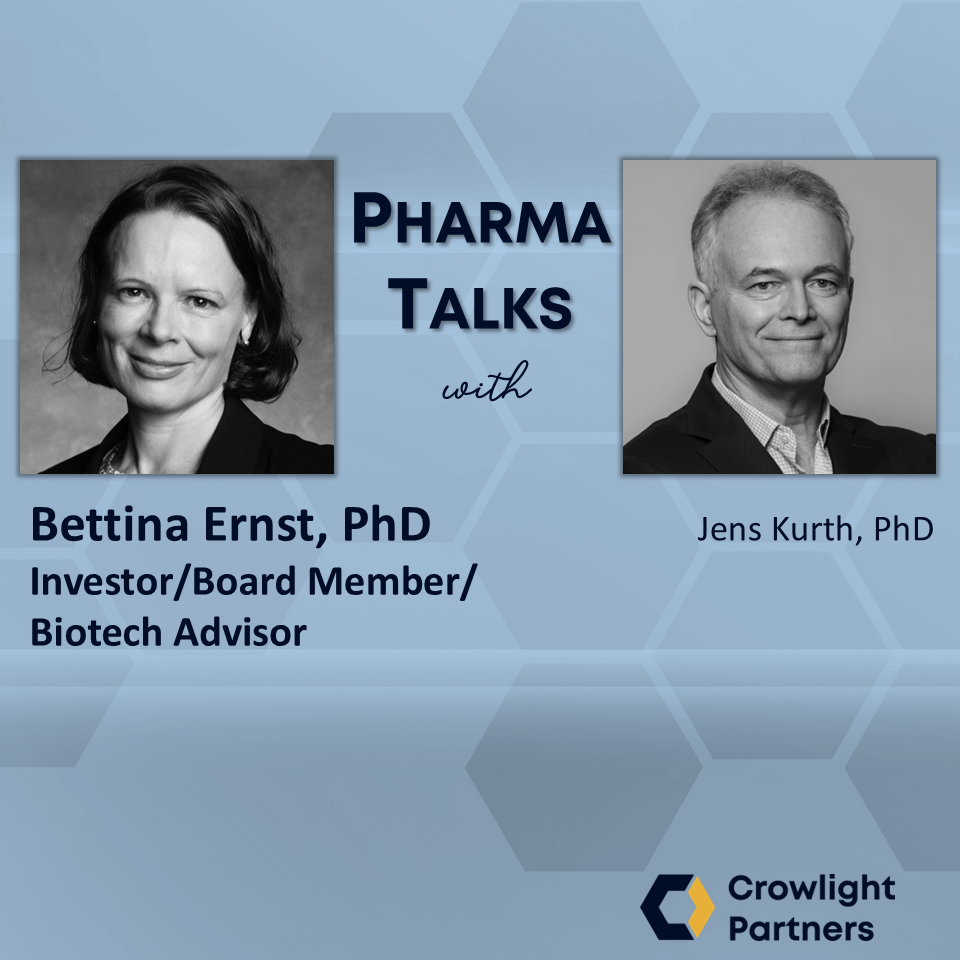
A Conversation with Dr. Bettina Ernst on Biotech Investing, Company Building and the Future of Innovation
26 August 2026
Europe continues to produce world-class biotechnology research, yet transforming scientific discoveries into successful companies has become increasingly challenging. Following the investment boom during the COVID years, investors have become far more selective, placing greater emphasis not only on scientific excellence but also on leadership, execution and strategic discipline.
Few people have observed this evolution as closely as Dr. Bettina Ernst. As an investor, board member and strategic advisor, she has worked with biotechnology companies throughout their entire journey, from academic discovery and company formation to financing, clinical development and value creation. Having witnessed both remarkable success stories and companies that ultimately failed despite outstanding science, she has developed a clear perspective on what investors really look for today.
In this edition of Pharma Talks, Dr. Bettina Ernst shares her thoughts on today’s financing environment, the qualities that distinguish successful founders, why execution matters just as much as science, and how biotechnology companies can create sustainable value in an increasingly competitive market.
The Investment Landscape
Pharma Talks: The biotech investment environment has changed significantly over the past decade. From your perspective, what are the most important changes in how investors evaluate opportunities today?
Dr. Bettina Ernst:
“I think the years leading up to and during COVID created a bubble. There was simply too much money invested in biotechnology, and in many cases capital flowed into companies that probably were not yet investable. We saw IPOs at extremely high valuations, but the same was true for private companies. Even in Switzerland, early-stage valuations reached levels that, in hindsight, were simply too high.
That inevitably led to a correction. Unfortunately, some companies had to disappear, even though their science was excellent. It was a painful correction, but probably a necessary one. I also believe we are still living with the consequences of that period.
Today it is still very difficult to finance biotechnology companies, particularly in the early stages. Clinical-stage companies may find it somewhat easier, but overall the financing environment remains very challenging. Companies therefore need to be much more open to partnerships and much more creative in finding ways to move their assets forward.”
Pharma Talks: I completely agree. We see exactly the same development. Even though new funds continue to emerge, investors are looking much more carefully at the risks today. Can the programme really be developed? Can it reach the clinic? How strong is the intellectual property? Compared with six or seven years ago, it has clearly become much more selective.
Dr. Bettina Ernst:
“Exactly. I often describe the COVID years as the golden years for biotechnology. COVID created an enormous wave of innovation, but eventually every bubble is followed by a correction. That is simply what happened.”
Science versus Execution
Pharma Talks: Outstanding science is essential, but it is rarely sufficient on its own. What distinguishes a scientifically exciting project from a company you would seriously consider investing in?
Dr. Bettina Ernst:
“For me, science is non-negotiable. Without outstanding science there is no biotechnology company. But execution is equally non-negotiable.
Scientific founders are often exceptional researchers, but they are not necessarily experts in development or execution. That is perfectly acceptable. What matters is that they recognise this and are willing to strengthen their management team with people who can take responsibility for development and execution.
Without proper execution, even the best science will never fulfil its potential.
I recently had the opportunity to speak with the Hong Kong Secretary for Health and one point came up during that discussion that has stayed with me ever since. We were talking about Switzerland being recognised as one of the world’s most innovative countries. But innovation that never reaches the market is not really innovation. The same applies to biotechnology. The best science without proper execution ultimately creates very little value.”
Pharma Talks: I completely agree. From an investor’s perspective, how do you assess execution? It is obviously much harder to evaluate than the science itself.
Dr. Bettina Ernst:
“One thing I find very valuable is to follow management teams over a period of time before making an investment. Founders will often explain what they plan to achieve over the next six months. When you meet them again, you can see whether they have actually delivered what they originally promised.
Of course, plans change. Companies sometimes need to pivot because experiments don’t work or because they discover a better solution. That is completely normal.
What matters is how they progress, how they think, how they communicate and whether they continue moving the company forward. That tells you a great deal about their ability to execute.”
The Founding Team
Pharma Talks: The founding team is another aspect you have already touched on, and it seems to be absolutely critical. How much importance do you place on the founders themselves when making an investment decision?
Dr. Bettina Ernst:
“There are different philosophies among investors. Some venture capital firms prefer to put the founding team together themselves. They identify the science, bring in experienced entrepreneurs and essentially build the company around the technology. There are certainly pros and cons to that approach.
Personally, however, I very much like founder-led companies, especially when the founder has spent ten years or more working on the underlying science. If somebody has dedicated that much time to one scientific question, they usually have an exceptional understanding of the biology. More importantly, they have already demonstrated perseverance. They have believed in the science for many years and have continued despite setbacks and uncertainty.
Founders who have spent many years developing the underlying science usually believe deeply in their programme because they know it inside out. I think scientific founders often have much greater resilience than a serial entrepreneur who is brought in by a venture capital firm. If things don’t work out, a professional manager can simply move on to the next opportunity because the emotional attachment is very different.
Of course, founders can also become too emotionally attached to their programme. That is where investors have an important role. They need to help founders remain objective, establish a realistic development plan and recognise when something needs to change.
If somebody has spent ten years developing a programme in an academic environment, they have usually had enough time to understand whether the underlying scientific concept is really robust. After that, the challenge becomes execution.”
Pharma Talks: I fully agree. I see something very similar in my own work with scientists. They are naturally focused on the science, whereas we immediately start talking about intellectual property, freedom to operate and how the programme can ultimately be translated into a company. It is a very interesting transition.
Dr. Bettina Ernst:
“Exactly. At that stage the discussion shifts from science to execution.”
Early Red Flags
Pharma Talks: What are the early red flags that make you decide not to invest in a company?
Dr. Bettina Ernst:
“One of the biggest red flags for me is a lack of transparency. If founders are not prepared to openly share their data, discuss the science honestly or talk about risks and experiments that may not have produced the expected results, that immediately raises concerns. Transparency and open communication are absolutely essential.
Another important red flag is the absence of a clear development plan. Founders need to have the end in mind from the very beginning. They should understand the patient population, the clinical pathway, whether the trial is feasible, whether manufacturing is manageable and what the cost of goods might ultimately look like. In other words, they need to understand the whole picture.
The competitive landscape is equally important. If founders do not know how their programme compares with existing approaches or where it fits into the market, that is another significant warning sign.
Finally, I always like to see clearly defined de-risking milestones, or value-inflection points. At every stage of development there should be one critical experiment that answers an important question and significantly reduces uncertainty. Those milestones can often be defined before development even starts. Of course, plans will evolve and companies may need to pivot, but founders should already have thought through this process before they ask investors for money.
As an investor, I want to see that founders not only have a development plan, but that they truly understand it, believe in it and are committed to executing it.”
Pharma Talks: I completely agree. That is actually something I spend a lot of time working on as well, helping founders think backwards from the end of development, understand the medical need, define the competitive landscape and identify what is really required to move a programme forward.
Dr. Bettina Ernst:
“Exactly. That kind of preparation makes a tremendous difference.”
Leadership
Pharma Talks: Another point that I find very interesting is leadership. Founders naturally become CEOs when the company is created, but at some point the company changes. From an investor’s perspective, do founders need to recognise that there may come a stage where someone else should lead the company?
Dr. Bettina Ernst:
“I think that is a discussion that should happen much earlier than it usually does.
Sometimes founders feel that because they started the company they also have to remain CEO throughout the entire journey. I don’t think that is necessarily the right approach.
I have seen an excellent example where a founder stepped back into the role of Chief Scientific Officer while an experienced CEO was brought in. At the same time, the founder worked closely with an outstanding chairman who acted as a mentor over the following years. Eventually, he grew into the CEO role himself.
Looking back, I think that was probably the best possible outcome, both for the individual and for the company.
Building a biotechnology company is a long journey, and leadership requirements change over time. A certain degree of flexibility is extremely valuable, even though it is not always an easy discussion to have.”
Value Creation
Pharma Talks: Looking across the companies you have worked with, what differentiates those that consistently create value from those that struggle despite promising science? That’s something I see quite often as well. Companies have excellent science, but they don’t really know how to translate it into preclinical development, into the clinic, or even which patients and indications they should focus on.
Dr. Bettina Ernst:
“I think it all comes back to having a very clear development plan and a realistic understanding of the resources required to execute it. Companies need to stay focused and avoid doing science simply for the sake of doing science. They also need financial discipline and should carefully consider how they spend their money. Building a large laboratory, for example, is not always the best use of limited resources at an early stage.
Ultimately, it comes back to having a clear development plan, maintaining focus and using resources in a disciplined way. Companies need to understand exactly what they want to achieve, how they are going to get there and what resources are required to reach each milestone.”
Pharma Talks: Do you also think the choice of indication is critical? I have seen companies deliberately choose large indications because they appeared to offer the greatest commercial opportunity. From your perspective, is the largest indication always the right place to start?
Dr. Bettina Ernst:
“Yes, I think that happens quite often, and unfortunately it is not only management teams that make that mistake. Boards sometimes make the same decision because they naturally focus on large markets with a high unmet medical need.
However, I think companies should carefully consider whether the first indication is really the right one. Sometimes it is much more sensible to choose a smaller indication where the clinical development pathway is feasible and where the company can reach a meaningful clinical endpoint relatively quickly. Once that proof of concept has been established, it becomes much easier to attract investors and expand into larger indications later.
The first indication should create value by demonstrating that the technology works. That is often a much better strategy than trying to tackle the largest market from the very beginning.”
Europe – Future
Pharma Talks: Europe continues to produce outstanding science, yet relatively few biotechnology companies become global leaders. From your point of view, what are the biggest barriers?
Dr. Bettina Ernst:
“I actually think the European biotechnology ecosystem has improved significantly over the past twenty years. One of the biggest changes has been the emergence of serial entrepreneurs who are now building their second or third companies. That experience is extremely valuable and is gradually strengthening the ecosystem.
At the same time, Europe is still very different from the United States. If you look at Boston, San Diego or the San Francisco Bay Area, you simply find a much larger biotechnology industry. There is easier access to venture capital, there is a much larger pool of experienced talent and there are many more opportunities to recruit people who have already built successful companies.
Investors are also naturally more comfortable investing in companies that are part of those established ecosystems.
On the other hand, I also see experienced people returning to Europe, and I think that is very positive. Europe has excellent science and outstanding universities. The scientific foundation is there. The challenge is to continue building the entrepreneurial experience that allows more of this science to develop into globally successful biotechnology companies.
The US biotechnology industry is still considerably larger than Europe’s, and that is simply the reality today.”
Pharma Talks: Do you think Europe primarily needs more venture capital, or does it need more experienced founders and executives who have already built biotechnology companies before?
Dr. Bettina Ernst:
“It clearly takes both. Capital alone is not enough if it is not deployed wisely. Experience is what helps ensure strong judgement, disciplined execution and the effective use of that capital.”
The Next Decade
Pharma Talks: Europe continues to produce outstanding science, but relatively few biotechnology companies become global leaders. Looking ahead, where do you see the greatest opportunities in biotechnology over the next five to ten years?
Dr. Bettina Ernst:
“I think there are several areas that are particularly exciting. One is certainly the shift we are seeing in cell therapy. For example, in CAR-T, there is increasing interest in moving from ex vivo approaches towards in vivo technologies. If we can eventually achieve the same outcome directly in the patient, these therapies could become much more accessible and easier to deliver.
I have also seen fascinating developments in completely different areas such as regenerative medicines, neuroscience and neurodegenerative diseases.
Another interesting example I recently came across is the production of platelets from cell lines. If that becomes feasible on a larger scale, we may become much less dependent on blood donations. These are developments that, only a few years ago, would have sounded almost like science fiction.”
Pharma Talks: I also think monitoring and biomarkers will become increasingly important. There are already companies using next-generation sequencing together with artificial intelligence to identify mutations that could indicate a future disease risk and then monitor those individuals over time. AI seems to be becoming an important part of that process.
Dr. Bettina Ernst:
“I completely agree. I think biomarkers, digital technologies and continuous monitoring will become increasingly important. The interesting question is whether we will eventually be able to monitor health in such a way that intervention becomes possible much earlier, perhaps even before a disease develops.
That immediately raises another question. Will reimbursement systems evolve as well? Today, reimbursement is generally linked to treating an established disease. In the future, could healthcare systems also reimburse interventions that prevent disease before symptoms appear? I think these discussions have already started and will become increasingly important.”
Pharma Talks: That is certainly a fascinating development.
Dr. Bettina Ernst:
“Another area that I personally find extremely interesting is the regulatory genome, including long non-coding RNAs. In my view, this field has the potential to fundamentally change the way we understand biology and disease
If these approaches can be successfully translated into medicines, they may allow us to modulate pathological cellular programmes by targeting regulatory mechanisms that have traditionally been considered difficult to address.
It is still an early field, and its clinical potential remains to be demonstrated. However, if successful, it could represent an important new therapeutic modality and may ultimately prove as transformative as some of the major therapeutic innovations introduced over previous decades.”
Advice to Founders
Pharma Talks: What kind of advice would you give first-time founders before they approach investors?
Dr. Bettina Ernst:
“My advice would be to develop a very clear development plan before raising capital. Founders should have the end in mind from the very beginning. They need to understand the de-risking milestones, the key clinical experiments, the amount of capital that will be required and the overall development strategy.
That also means understanding the indication, the feasibility of the clinical trial, the endpoints that need to be achieved, the biomarkers required for patient selection and, increasingly, the manufacturing strategy. CMC has been underestimated for many years, but today it has become a critical element of successful product development.
Investors want to see that founders have thought through the entire journey before they ask for funding. The science may be excellent, but it needs to be supported by a realistic development strategy.”
Pharma Talks: I completely agree. Manufacturing and CMC have become much more important than they were a few years ago.
Dr. Bettina Ernst:
“Absolutely. They have been underestimated for a long time, but today they are an essential part of building a successful biotechnology company.
Pharma Talks: Looking back at all the companies you’ve worked with, what is the one lesson you wish every first-time founder understood before raising their first financing round?
Dr. Bettina Ernst:
My central advice would be: Do not simply raise money to continue the work. Raise enough money to answer a question that materially changes the value and future of the company.”
Final Question
Pharma Talks: Can great execution compensate for average science? Or can outstanding science compensate for poor execution?
Dr. Bettina Ernst:
I think the science always needs to be solid. There is no substitute for good science.
At the same time, outstanding execution can create tremendous value, even when the innovation itself is more incremental than revolutionary. If you look at many of the assets coming out of China, for example, they are often not completely novel, but they are developed with remarkable discipline and speed. The execution is outstanding.
The opposite is much more difficult. Outstanding science alone cannot compensate for poor execution.
Ultimately, successful biotechnology companies need both, strong science and excellent execution.
The interview took place on 15 July 2026.