

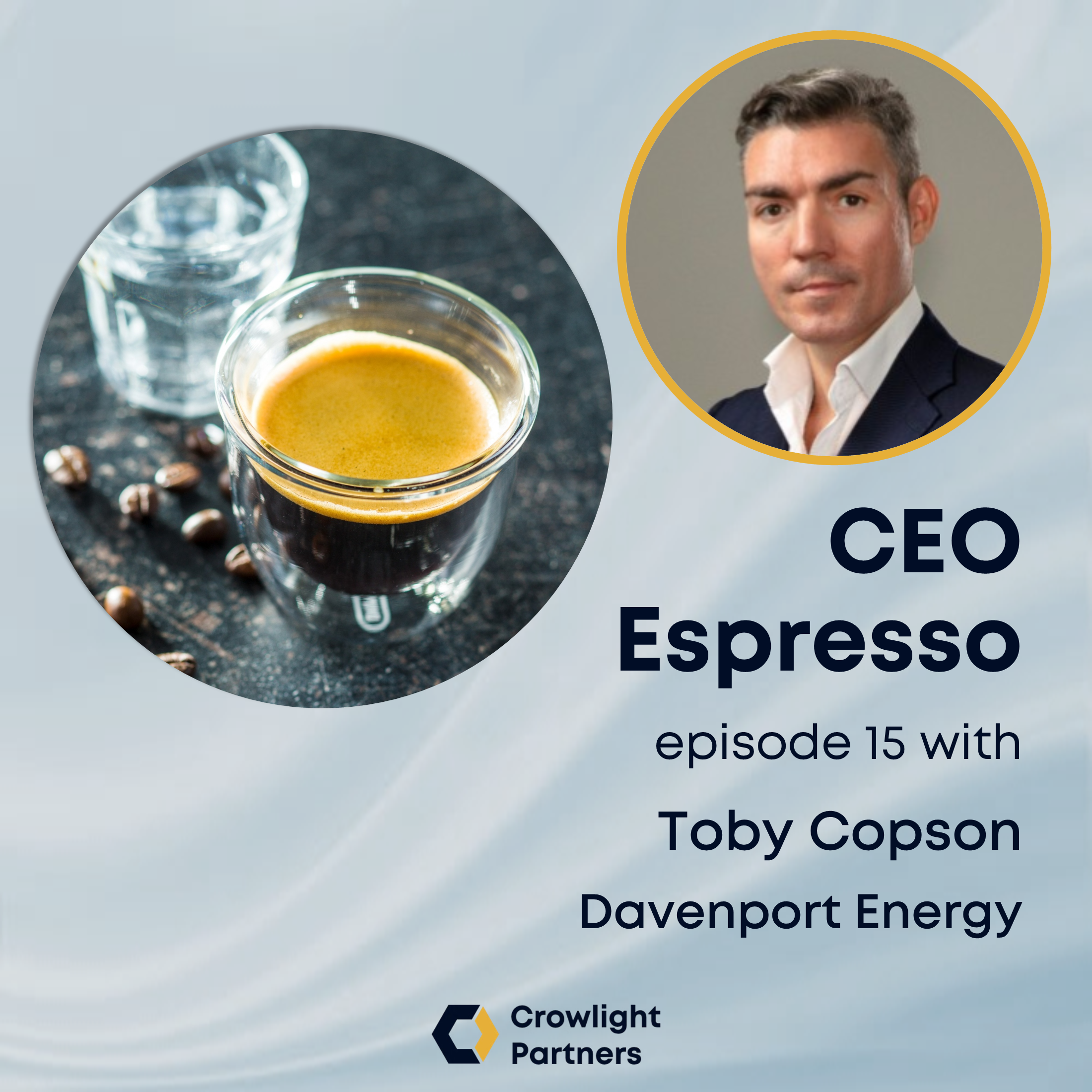
Toby Copson started trading oil at thirteen and has been doing it, on and off, from Shanghai and Singapore ever since — through two companies of his own, a stint helping Marex go public, and now as Managing Partner at Davenport Energy.
To kick things off, could you tell me about your trajectory in the industry?
I come from an oil family. My father had an oil company in the sixties and seventies alongside Algy Cluff, who is widely known as the godfather of British oil trading. Cluff had been an army officer in West Africa and was savvy enough to see an opportunity there; he and my father built up around 75 producing assets between West Africa and the North Sea.
For me, I went to boarding school, but traditional education was never going to be my path; I was a bit of a rebel and got evicted from Eton and others. I never finished university. Instead, from the age of 13, I was already learning the ropes of oil trading. I started in the back office in operations and was working in the middle office for some compliance. What really interested me was selling barrels. I grew up surrounded by big characters coming through the house, drinking with my father, and I knew I wanted to be just like them. So I was fortunate enough at thirteen to be given the keys and being told to “sink or swim”, selling Middle Eastern and West African barrels into the UK market, and I found my place.
How did you evolve from there and what took you to China, eventually?
As I got older, I needed to fly the nest to establish my own name. I wanted to be my own person rather than “Alex Copson’s son”. First, I moved into freight for a while, which turned out to be the most useful detour I ever took, because netbacks on freight are what make or break a deal. Building those connections with tanker owners and small refineries became the foundation when I started my own company.
I moved to China with Intercapital (ICAP) — I was their youngest managing director, running about a thousand headcount across Shanghai and Hong Kong. That’s also where I met my wife, whose father was a well-connected figure in Chinese business at the time. He was instrumental in creating trust. That kind of guanxi (关系) — the personal network Chinese business runs on — isn’t something an outsider can build alone. No Western trader was doing business at that level with the Chinese national oil companies back then — you were either dealt with government to government, or through the big trading houses who could offer deferred payment terms. I didn’t have any of that. I had a friend at an investment bank who gave me a $20 million credit line against $1.5 million of my own money, on the promise that if I utilized the full credit facility in the first year, they’d double it. We did that in six months, and it grew from there.
The business was built entirely on relationships with the Chinese refiners — these were profitable, legitimate cargoes, not underhanded deals. Early on, relationship-building followed local customs of the time, which have since evolved under China’s anti-corruption reforms.
After I sold my last company, Trident, I was retiring — I was 39, my son was three, and I’d made good money.
Retirement didn’t stick, though?
It lasted six months before my wife told me I needed to leave the house. Marex approached me about their APAC business ahead of a planned IPO; I was reluctant to come out of retirement, but the opportunity was compelling and we found terms that worked well for both sides. I stayed a year, took the region from about twenty people to a hundred and forty, and helped get their IPO off the ground. I left because I didn’t want to be part of a listed company — compliance was making it too hard to onboard clients I wanted to do business with.
I went back to that same investment bank and said, let’s do this again, but asset-heavy this time — buy refineries, trade the asset-backed strategies around them. Two years in, we’re already having a buyout conversation again. In any case, staying connected to the market scratches an itch I need to scratch. I’m quite visible at a few oil-centric conferences and on Bloomberg TV doing commentary, and I’m quite happy doing what I do.
What is your greatest asset — the key to your success?
I was lucky to have a strong support network in my family, and an upbringing around the industry, which gave me an early understanding of how much of a relationship business this really is. Even though screen-traded paper barrels have drastically overtaken physical trade volumes today, understanding actual trade flows and originations is vital – knowing which barrels suit which refiners, which markets. I’m indebted to my father and to that business for getting me involved so young.
What part of your current work are you most proud of?
What we’ve built in APAC, particularly in China. It was a genuine uphill battle to operate as a “Laowai” (的老外, foreigner) dealing directly with Chinese national oil companies and state-owned refiners like CNOOC and Sinopec. Most foreign players either dealt bilaterally through governments or large institutional trading houses that were far more asset-heavy and could offer highly favorable deferred contractual terms. Creating a foothold and becoming one of the trusted counterparties in that market is something I’m proud of.
You’ve built and exited businesses more than once now. How do you build a team — and a business — that’s designed for that kind of exit?
We were always light and nimble by design — never wanted compliance and paperwork dictating how fast we could react to the market. Everyone senior in the business is a partner and owns shares, which I learned from watching how Trafigura, Vitol and Gunvor operated in the early days, through my father. That ownership stake is what drives real commitment. We never set out to be revolutionary — we wanted to become enough of a thorn in the side of a major institution that they’d want to buy us. We’ve replicated that twice now. I’ve never been precious about the brand, even though it’s something I built with my partners — ultimately, making a profit and being able to hand off the responsibilities is what a successful exit looks like to me.
Negotiations must play a huge role in your business. Is there one that particularly stayed with you?
There isn’t a single deal so much as a lesson about cultural norms. I struggled early on with Chinese state-owned counterparties because I didn’t understand the etiquette — e.g., where you sit at a dinner after a meeting signals respect. My wife and her family helped steer me. But the first large oil deal we did with a Chinese state entity stands out, because no foreign desk was doing that kind of business directly at the time.
How do you make sure you’re shaping the terms of a negotiation rather than just reacting to your counterparty?
Every negotiation I approach, I never see the outcome as binary — that for us to win, they have to lose. With oil and energy trading especially, you need a genuine relationship with your counterparty: you need to know them in person, not just on the phone. If there’s something I can do to make their outcome better, I’ll do it, because that’s what a good partner does, and I’d hope for the same in return.
There are exceptions — some counterparties are purely there to maximise their own margin, and that’s understandable, I don’t hold it against them. But most traders I respect go into a deal thinking about making it as mutually beneficial as possible, adding longevity to the relationship. Because a one-off transaction doesn’t make for a good business. If it’s purely binary, you probably don’t do business with that counterparty again.
This longevity angle seems to be missing from Europe right now, doesn’t it — the industrial policy has become quite short-sighted, geopolitically speaking?
The whole of Europe has lost its globalist outlook and become very insular. There’s no harmony left; it’s everyone for themselves, and the rise of the far right plays into that. Some of what they argue has a rational core, but too often it’s wrapped in awful rhetoric, and that doesn’t make for good partners. Governments need to take a fresh look at that turn — Europe once had a genuinely globalist ambition.
How has your leadership style evolved over the years?
Dramatically. Early on, my style came from a very British, public-school environment — top-down, hierarchical, not especially pliable. That didn’t sit well with our Chinese colleagues, where the concept of “face” matters enormously — you don’t put someone in a position where they look bad or lose standing. I misstepped many times early on, not out of rudeness, just because how I was raised didn’t map onto that philosophy. I’ve become far more attuned to cultural differences, both internally and with counterparties. You have to understand what motivates someone before you can build a good partnership with them.
Is there anything you’re actively working on developing further?
Mostly personal traits. I know I can be difficult to work with. Patience isn’t something I have naturally, and that can come across unfavorably when dealing with people. I’ve had to work on that. Overall, I’ve become less uptight and less purely outcome-oriented, more focused on maintaining relationships even when at times the immediate result doesn’t favour us, as long as we’re not coming out badly.
How do you know when something inside the organisation is starting to deteriorate?
There’s an old line: very slowly, then all at once.[1] The early signs are rarely immediately obvious — small things you notice that didn’t quite work, and then one day it’s a culmination you can’t ignore. We try to catch it by giving good people autonomy. We don’t micromanage. If someone has a bad drawdown, we don’t treat it the way a hedge fund would — we work with them, because we hired them for a reason. We try to figure out what’s actually going on: a home issue, something professional, whatever it is. Of course, if you lose a lot of money, you’re going to be under scrutiny, but it isn’t ruthless here. We’re a private business, and a lot of the clients we have wouldn’t be here without the people we’ve kept.
You’re not under the illusion to know better than everybody else. You’re assuming that they know what they’re here to do.
There’s another good line I like: “I’m not young enough to know everything.”[2] I say it to my son sometimes, half joking, when he’s dead certain he’s right about something. But you genuinely can’t know everything, and you definitely can’t always know why a part of the organisation is excelling or starting to slip. You can have a good sense of it, but mostly it comes down to talking to people and staying close enough that nobody feels aggrieved — there have been exceptions, but they’re the exception, not the rule. Autonomy is part of our ethos, and it gives people their own self-respect within the organisation.
What’s the major achievement you have yet to accomplish?
Perhaps being the CEO of a publicly listed company. It’s appealing in the abstract — the scrutiny, the prestige — but I’ve been close enough to listed companies to know what gets sacrificed. What makes us who we are would erode quickly under shareholders who don’t fully understand the business but want inorganic growth regardless. A lot of businesses struggle when they chase the shiny new thing — AI, for example. Often, it turns out that’s a good way to lose money. Being able to tell what’s a mirage from what’s truly substantive — and acting on it — was the recipe for success in the past. So I’m torn: part of me wants it, part of me knows it would mean giving up a lot of what I think is right.
We conducted the interview in July 2026.
[1] Editorial note: In Hemingway’s 1926 novel The Sun Also Rises, the fictional character Mike Campbell, asked how he went bankrupt, replies: “Two ways. Gradually and then suddenly.”
[2] Editorial note: From J. M. Barrie’s play The Admirable Crichton (1902).