


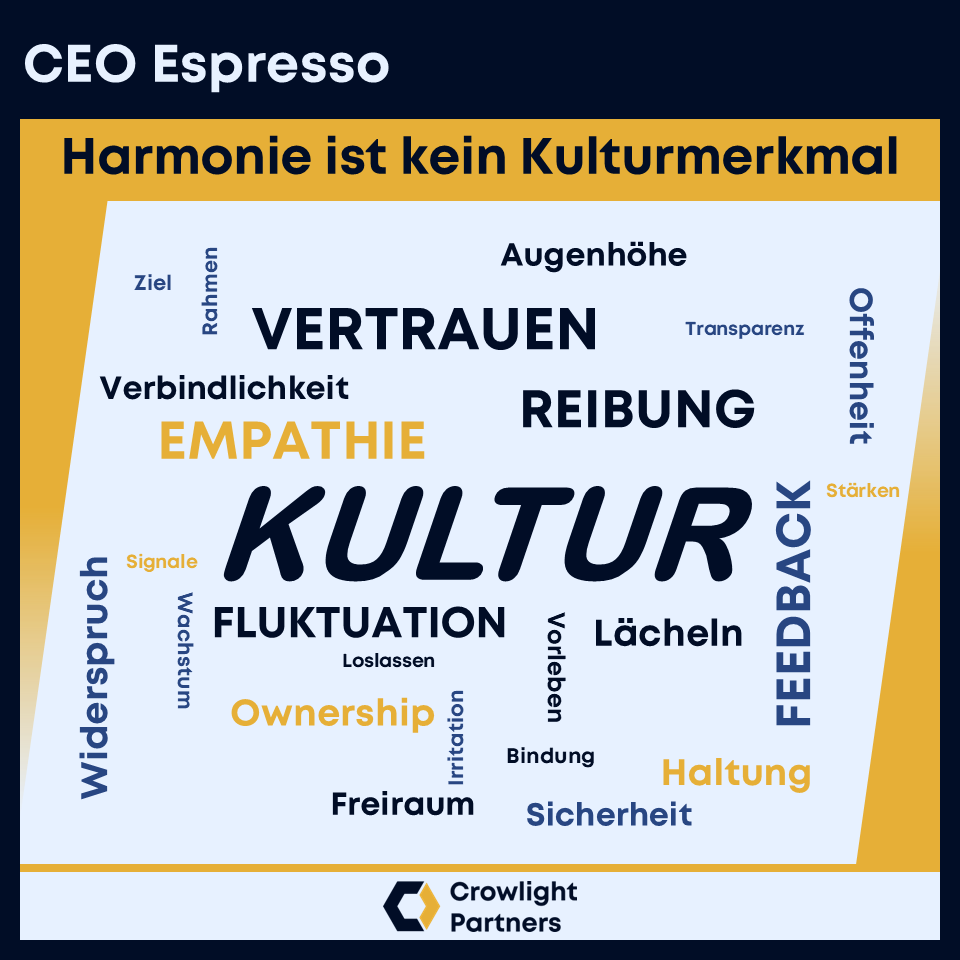
How does a leader know whether the culture is right?
Not through the annual employee survey. Not through the values statement on the wall. But through what happens every day — or doesn’t.
The answers from our interviewees were refreshingly concrete.
🔷 Guillaume Dubrule, CEO of Rexel Germany: “Do people dare to confront me with something that initially irritates me? For me, that is the strongest sign.”
🔷 Emmanuel Chéret, CEO of bsurance: “Dissent is welcome here. When people feel safe enough to disagree, trust is present.”
🔷 Stefan Günzel, Managing Director of INNOSYSTEC: “Healthy fluctuation. Not too much, not too little. Zero fluctuation sounds good — but it isn’t.”
Three different answers. And yet they all describe the same phenomenon: a healthy culture does not reveal itself in harmony, but in the ability to allow friction.
Dubrule puts it succinctly: culture cannot be decreed — it can only be lived by example. The proof is not the mood in an all-hands meeting. It is found in the moments when someone he rarely sees still speaks up.
Chéret’s benchmark is related, but sharper: dissent requires safety. Anyone who disagrees takes a risk. If they do so anyway, it is evidence of a culture of openness.
Günzel’s point about fluctuation may be the most honest indicator of all. Zero fluctuation does not mean that everyone is happy. It can also be a sign of resignation, of dangerous stagnation.
Culture cannot be decreed. But it can be observed — every day, in small signals.
+++ Deutsche Version +++ German version +++
Wie weiß eine Führungskraft, ob die Kultur stimmt?
Nicht durch die jährliche Mitarbeiterbefragung. Nicht durch das Leitbild an der Wand. Sondern durch das, was täglich passiert — oder eben nicht.
Die Antworten unserer Gesprächspartner waren erfrischend konkret.
🔷 Guillaume Dubrule, CEO von Rexel Germany: „Trauen sich Menschen, mich mit etwas zu konfrontieren, das mich im ersten Moment irritiert? Das ist für mich das stärkste Zeichen.”
🔷 Emmanuel Chéret, CEO von bsurance: „Widerspruch ist bei uns willkommen. Wenn Menschen sich sicher genug fühlen, um zu widersprechen, dann ist Vertrauen vorhanden.”
🔷 Stefan Günzel, Geschäftsführer von INNOSYSTEC: „Eine gesunde Fluktuation. Nicht zu viel, nicht zu wenig. Null Fluktuation klingt gut — ist es aber nicht.”
Drei verschiedene Antworten. Und doch beschreiben alle dasselbe Phänomen: Gesunde Kultur zeigt sich nicht in Harmonie, sondern in der Fähigkeit, Reibung zuzulassen.
Dubrule bringt es auf den Punkt: Kultur lässt sich nicht verordnen— man kann sie nur vorleben. Der Beweis dafür ist nicht die Stimmung im All-Hands-Meeting. Es sind die Momente, in denen jemand, den er selten sieht, trotzdem den Mund aufmacht.
Chérets Maßstab ist verwandt, aber schärfer: Widerspruch setzt Sicherheit voraus. Wer widerspricht, riskiert etwas. Tut er es trotzdem, zeugt das von einer Kultur von Offenheit.
Günzels Hinweis auf die Fluktuation ist dabei vielleicht der ehrlichste Gradmesser von allen. Null Fluktuation bedeutet nicht, dass alle glücklich sind. Es kann auch ein Zeichen von Kapitulation sein, von gefährlichem Stillstand.
Kultur lässt sich nicht verordnen. Aber sie lässt sich ablesen — jeden Tag, in kleinen Signalen.