


日本語版は下記をご覧ください
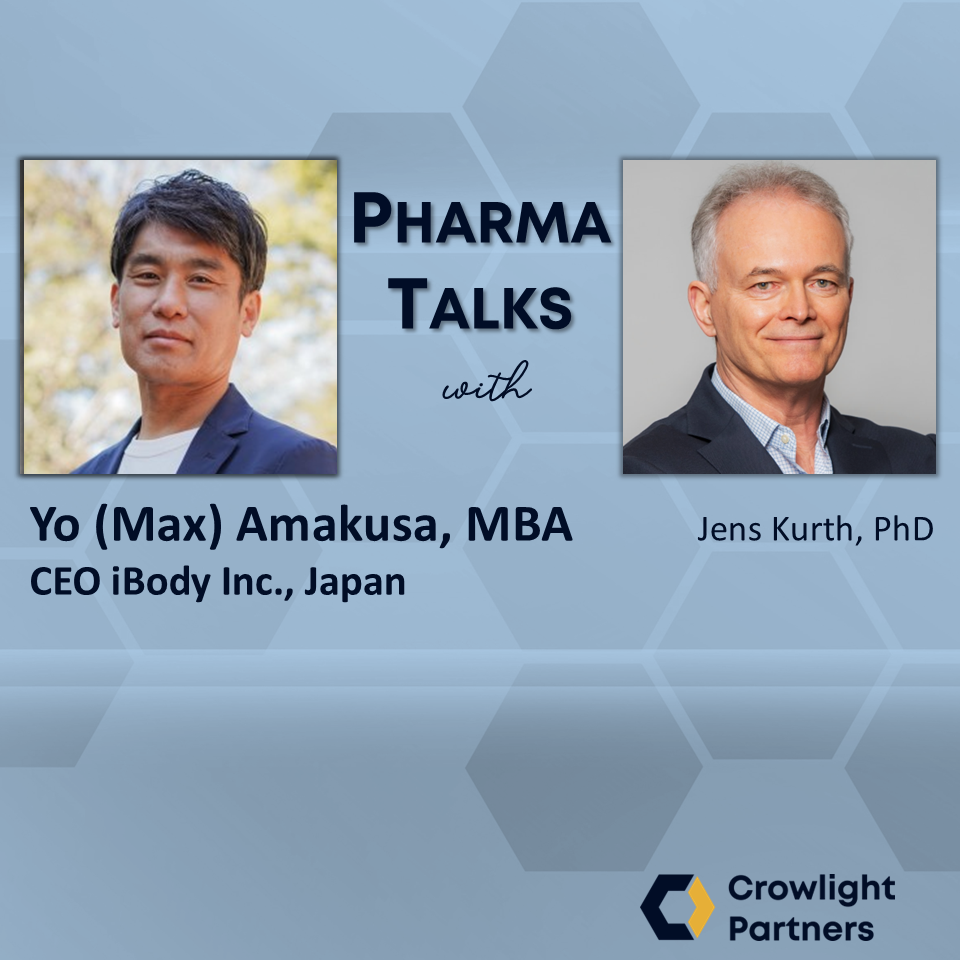
A Pharma Talks Interview with Yo (Max) Amakusa, CEO of iBody
Great science is the foundation of many successful life science companies. But turning scientific innovation into real-world value requires more than technology alone.
In this edition of Pharma Talks, we speak with Yo (Max) Amakusa, CEO of iBody Inc., a Japan-based antibody discovery company.
Our conversation explores iBody’s evolution from therapeutic antibodies into diagnostics and bioanalytics, the potential of AI in antibody discovery, and the importance of partnerships and international collaboration. Above all, Amakusa-san shares a clear perspective on building a life science company: scientific excellence is the starting point, but lasting value is created through real-world application, strong partnerships and trust.
1. The evolution of iBody
Jens Kurth: iBody initially focused on therapeutic antibodies before successfully expanding into diagnostic antibodies. What led to this strategic shift, and what opportunities did you see that others perhaps overlooked?
Amakusa-san: Initially, our goal was to use our proprietary antibody discovery platform to develop our own therapeutic antibodies. We continue to explore opportunities in therapeutics today, but along the way, our rabbit antibody discovery technology began attracting strong interest from diagnostic companies and bioanalytics researchers, who consistently need highly functional antibodies for product development and analytical applications.
In particular, we found strong demand for antibodies that can distinguish very subtle molecular differences—such as small-molecule antigens, single amino acid mutations, and phosphorylation—with both extremely high specificity and affinity. These characteristics are particularly valuable in diagnostic and detection applications. Recognizing this opportunity, we actively expanded our business into diagnostics and bioanalytics, where the strengths of our technology can directly address unmet needs.
2. Diagnostic Antibodies
Jens Kurth: How do you see the role of diagnostic antibodies evolving over the next five to ten years?
Amakusa-san: I believe diagnostic antibodies will become more sensitive, more specific, and more versatile.
Today, many diagnostic tests focus on detecting a single biomarker. In the future, I think we will see more multiplex testing, where several biomarkers are measured at the same time.
Diagnostics will also move closer to patients through point-of-care and rapid testing.
As diagnostics become more advanced, the performance of the antibody itself will become even more important. Better antibodies will enable faster, more accurate, and more informative diagnostics.
3. Precision Medicine
Jens Kurth: As precision medicine continues to evolve, where do you believe diagnostic antibodies will have the greatest clinical impact?
Amakusa-san: I believe the greatest impact will be in selecting the right treatment for each patient.
Patients with the same disease may respond very differently to the same treatment. Diagnostic antibodies can help identify specific biomarkers that tell us which patients are most likely to benefit from a particular therapy.
They can also help monitor how a patient is responding to treatment and detect changes in the disease over time.
So, I see diagnostic antibodies becoming an important bridge between diagnosis and treatment — helping us move toward the right treatment for the right patient at the right time.
4. Japan vs Europe
Jens Kurth: Having built iBody in Japan, what differences do you see between the Japanese and European innovation ecosystems?
Amakusa-san: One difference I see is the role of regional biotech clusters.
In Europe, biotech clusters are very active, and companies, universities, investors, and other organizations are well connected within each region.
At the same time, because European countries are geographically close and well connected, these networks can easily expand across borders. A company in Belgium, for example, can naturally work with partners in France, Germany, Switzerland, or other countries.
In Japan, we tend to build the ecosystem mainly within Japan. Europe, on the other hand, has a strong advantage in building cross-border ecosystems and looking at the European market as a whole.
I think this creates more opportunities for collaboration and makes it easier for biotech companies to think internationally from an early stage.
5. Partnering
Jens Kurth: What makes a pharmaceutical or diagnostics company an attractive partner for iBody?
Amakusa-san: iBody is an antibody discovery technology company. We do not have our own therapeutic or diagnostic targets.
So, for us, the ideal partner is a company whose strengths complement ours. Our partners bring their targets, disease knowledge, and development expertise, while we bring our antibody discovery technology.
The goal can be either drug discovery or diagnostic development. Both are important to us.
Most importantly, we want to build long-term partnerships. Rather than working together on just one project, we want to contribute to the development of many products over time.
I believe the best partnerships are those where both sides bring different strengths and create value together.
6. Lessons learned
Jens Kurth: Looking back over the past years as CEO, what has been your biggest lesson in building strategic partnerships?
Amakusa-san: The biggest lesson I have learned is that a strong partnership must create value for both sides.
A good example is our strategic capital and business partnership with TAUNS, a Japanese diagnostics company.
We contribute to their product development through our antibody discovery technology. At the same time, their investment allows us to further improve our technology and strengthen our business.
As our technology becomes stronger, we can create even more value for TAUNS and other partners.
So, for me, the best partnership is not simply about exchanging technology or money. It is about creating a win-win relationship where both companies can grow together over the long term.
7. Innovation
Jens Kurth: What trends in antibody discovery or diagnostics excite you most today?
Amakusa-san: AI is a topic we hear about everywhere today, but I am very excited about its potential in antibody discovery.
We have already started feasibility studies to combine AI with our experimental antibody discovery approach.
By combining AI-based prediction and design with our experimental technology, we believe we can discover better and more valuable antibodies.
Ultimately, our goal is not simply to use AI. Our goal is to use the best combination of AI and experimental approaches to improve and accelerate the development of new therapeutics and diagnostics.
8. Leadership
Jens Kurth: How do you balance scientific excellence with commercial execution?
Amakusa-san: One of the unique strengths of iBody is the combination of science and business.
iBody was founded by scientists, and I later joined the company with many years of business experience.
My role is to translate the scientific value created from university research into services and messages that the market can understand, and ultimately into real value for society.
By bringing our technology into real-world drug and diagnostic development, we gain experience, learn from our partners, and continuously improve and refine our technology.
I believe an important role of leadership is to create this positive cycle: great science creates real-world value, and real-world experience makes the science even better.
9. Europe
Jens Kurth: Why is Europe strategically important for iBody’s future?
Amakusa-san: Europe is strategically very important for iBody because it has a strong ecosystem in both pharmaceutical and diagnostic development.
There are many world-leading pharmaceutical and diagnostic companies, innovative biotech companies, and excellent research institutions across Europe.
For iBody, Europe is not simply a market where we want to sell our antibody discovery services. We want to build strong partnerships and become part of the European innovation ecosystem.
By working closely with European partners we can bring our antibody discovery technology into more drug and diagnostic development programs, learn from those collaborations, and continue to improve our technology.
So, Europe is an important part of our long-term global growth strategy.
10. Advice
Jens Kurth: What advice would you give entrepreneurs building innovative life science companies today?
Amakusa-san: My advice is: don’t focus only on your technology.
In life science, we often start with great science or innovative technology. But great technology alone does not create a successful company.
You need to understand what real problem your technology can solve, who needs it, and how you can deliver that value to them.
It is also very important to listen to customers and partners. Their feedback can help you improve not only your business, but also your technology.
So, my advice is to go outside the lab, talk to people, and test your ideas in the real world as early as possible.
Great science is the starting point. Turning it into real value is what builds a company.
Closing question
„Looking back over your career, what is one lesson you wish you had learned much earlier about building international collaborations?“
If I could go back, I would start building international relationships much earlier.
Especially since the COVID pandemic, online meetings have become a normal part of business. They are very useful, but I have learned that face-to-face communication is still extremely important.
And it is not enough to meet someone just once. Meeting people again and again, visiting their companies, and spending time together builds a much deeper level of trust.
I have learned that international collaboration is not created simply by having good technology or a good business proposal. In the end, it is built on trust between people.
Once that trust is established, new opportunities often come naturally, sometimes in ways you never expected.
So, if I could give my younger self one piece of advice, it would be: go out into the world, meet people face-to-face, and keep building those relationships over time.
The interview took place on 27 August 2026.
抗体イノベーションを社会における真の価値へ
Pharma Talks インタビュー:iBody CEO Yo (Max) Amakusa(天草)氏に聞く
優れたサイエンスは、多くのライフサイエンス企業の成功を支える基盤です。しかし、科学的イノベーションを社会における真の価値へとつなげるためには、優れた技術だけでは十分ではありません。
今回の Pharma Talks では、日本発の抗体探索企業 iBody Inc. の CEO、Yo (Max) Amakusa(天草)さんにお話を伺いました。
本インタビューでは、iBody が治療用抗体から診断・バイオアナリティクス分野へと展開してきた背景、抗体探索における AI の可能性、そしてパートナーシップや国際的なコラボレーションの重要性についてお話しいただきました。
そして何より、天草さんはライフサイエンス企業を築くうえでの明確な考えを語っています。優れたサイエンスは出発点であり、そこから持続的な価値を生み出すためには、実社会での応用、強固なパートナーシップ、そして人と人との信頼が不可欠です。
1. iBodyの進化
iBodyは当初、治療用抗体に注力していましたが、その後、診断用抗体の分野にも展開し、成功を収めています。この戦略的な展開の背景には何があったのでしょうか。また、他社が見落としていたかもしれない、どのような可能性を見出したのでしょうか?
天草さん:
はい、当初は自社の優れたプラットフォームを用いた創薬を目指していました。もちろん現在も創薬の可能性は追い続けていますが、当社のウサギ抗体探索は、製品開発に常に高機能な抗体を必要とする診断薬企業やバイオアナリティクスの研究者から注目をあつめるようになりました 。特に低分子抗原や1アミノ酸変異、リン酸化に極めて特異的で親和性も高い抗体は診断、検出用のニーズが高いことが分かり積極的な事業展開を行いました。
2. 診断用抗体
今後5〜10年で、診断用抗体の役割はどのように変化していくと考えていますか?
天草さん:
今後、診断用抗体は、より高感度、高特異性になり、さらに幅広い用途で使われるようになると考えています。
現在、多くの診断検査では単一のバイオマーカーを検出していますが、将来は複数のバイオマーカーを同時に測定するマルチプレックス検査が増えていくでしょう。
また、ポイント・オブ・ケア検査や迅速検査によって、診断はより患者さんに近い場所で行われるようになると思います。
診断技術が高度になるほど、抗体そのものの性能がさらに重要になります。より良い抗体が、より迅速で正確、そしてより多くの情報を提供できる診断を可能にすると考えています。
3. プレシジョン・メディシン(精密医療)
プレシジョン・メディシンが進展していく中で、診断用抗体はどの領域で最も大きな臨床的インパクトをもたらすと考えていますか?
天草さん:
最も大きなインパクトがあるのは、患者さん一人ひとりに適した治療を選択することだと考えています。
同じ病気の患者さんでも、同じ治療に対する反応は大きく異なることがあります。診断用抗体によって特定のバイオマーカーを検出することで、どの患者さんが特定の治療から最も効果を得られる可能性が高いかを判断できるようになります。
また、治療に対する患者さんの反応をモニタリングしたり、時間とともに起こる病気の変化を捉えたりすることにも役立ちます。
つまり、診断用抗体は診断と治療をつなぐ重要な橋渡しになっていくと思います。
4. 日本と欧州
日本でiBodyを成長させてきた経験から、日本と欧州のイノベーション・エコシステムにはどのような違いがあると感じていますか?
天草さん:
私が感じる違いの一つは、地域のバイオクラスターが果たしている役割です。
欧州ではバイオクラスターが非常に活発で、それぞれの地域で企業、大学、投資家、その他の組織が密接につながっています。
同時に、欧州の国々は地理的に近く、互いにつながっているため、こうしたネットワークが国境を越えて広がりやすいと感じます。例えばベルギーの企業が、フランス、ドイツ、スイスなどのパートナーと自然に連携することができます。
日本では、エコシステムを主に日本国内で構築する傾向があります。一方、欧州には、国境を越えたエコシステムを構築し、欧州市場全体を一つのマーケットとして捉えやすいという大きな強みがあります。
その結果、コラボレーションの機会が増え、バイオテック企業が早い段階から国際的な視点を持ちやすいのではないかと思います。
5. パートナーシップ
iBodyにとって、魅力的なパートナーとなる製薬企業や診断薬企業とは、どのような企業でしょうか?
天草さん:
iBodyは抗体探索技術の会社です。私たちは自社で治療や診断のターゲットを持っているわけではありません。
そのため、私たちにとって理想的なパートナーは、お互いの強みが補完関係になる企業です。パートナーはターゲットや疾患に関する知識、開発力を持ち、私たちは抗体探索技術を提供します。
その目的は、創薬でも診断薬開発でも構いません。どちらも私たちにとって重要です。
そして最も重要なのは、長期的なパートナーシップを築くことです。一つのプロジェクトだけで終わるのではなく、長期にわたって多くの製品開発に貢献していきたいと考えています。
私は、お互いが異なる強みを持ち寄り、一緒に新しい価値を生み出せる関係こそ、最も良いパートナーシップだと考えています。
6. これまでに学んだこと
CEOとしてこれまでを振り返ったとき、戦略的パートナーシップを構築するうえで最も大きな学びは何でしたか?
天草さん:
私が学んだ最も大きなことは、強いパートナーシップは、双方に価値を生み出すWin-Winの関係でなければならないということです。
その良い例が、日本の診断薬企業であるTAUNSとの戦略的な資本業務提携です。
私たちは抗体探索技術によってTAUNSの製品開発に貢献しています。一方で、TAUNSからの出資によって、私たちはさらに技術を高め、事業を強化することができます。
そして私たちの技術がさらに強くなれば、TAUNSをはじめとするパートナーに、より大きな価値を提供できるようになります。
ですから私にとって理想的なパートナーシップとは、単に技術や資金を交換する関係ではありません。お互いが価値を生み出し、長期的に一緒に成長していけるWin-Winの関係だと考えています。
7. イノベーション
現在、抗体探索や診断分野において、最も期待している、あるいはワクワクしているトレンドは何ですか?
天草さん:
AIは現在、あらゆるところで非常によく話題になるテーマですが、私は抗体探索におけるAIの可能性に非常に期待しています。
私たちはすでに、AIと当社の実験的な抗体探索アプローチを組み合わせるためのフィージビリティスタディを開始しています。
AIによる予測や設計と、私たちの実験技術を組み合わせることで、より優れた、より価値の高い抗体を発見できると考えています。
最終的な目的は、単にAIを使うことではありません。AIと実験的アプローチを最適に組み合わせることで、新しい治療薬や診断薬の開発をより良いものにし、さらに加速することが私たちの目標です。
8. リーダーシップ
科学的な卓越性と、ビジネスとして成果を出すことを、どのように両立していますか?
天草さん:
iBodyのユニークな強みの一つは、科学とビジネスの組み合わせです。
iBodyは科学者によって創業され、そこに長年のビジネス経験を持つ私が後から加わりました。
私の役割は、大学発の研究から生まれた科学的な価値を、市場に理解されるサービスやメッセージに変換し、最終的に社会に実際の価値として届けることです。
そして、私たちの技術を実際の創薬や診断薬開発の現場で使うことで、経験を積み、パートナーから学び、技術そのものを継続的に高度化、洗練していくことができます。
私は、このプラスの循環を生み出すことが、リーダーとして重要な役割だと考えています。
「優れた科学が社会での価値を生み、社会での実践経験が科学をさらに良くする。」
9. 欧州
iBodyの将来にとって、なぜ欧州が戦略的に重要なのでしょうか?
天草さん:
欧州は、医薬品と診断薬の両方で非常に強いエコシステムを持っているため、iBodyにとって戦略的に非常に重要です。
欧州には、世界をリードする製薬企業や診断薬企業、革新的なバイオテック企業、そして優れた研究機関が数多く存在しています。
iBodyにとって欧州は、単に抗体探索サービスを販売したい市場ではありません。強いパートナーシップを構築し、欧州のイノベーション・エコシステムの一員になりたいと考えています。
欧州のパートナーと密接に連携することで、私たちの抗体探索技術をより多くの創薬・診断薬開発プログラムに活用し、そこから学び、さらに技術を高めていくことができます。
その意味で、欧州はiBodyの長期的なグローバル成長戦略において重要な地域だと考えています。
10. アドバイス
現在、革新的なライフサイエンス企業を立ち上げ、成長させようとしている起業家に、どのようなアドバイスをしますか?
天草さん:
私からのアドバイスは、自分たちの技術だけに集中しすぎないことです。
ライフサイエンスでは、優れた科学や革新的な技術から事業が始まることが多いと思います。しかし、優れた技術があるだけでは、会社を成功させることはできません。
その技術が実際にどのような課題を解決できるのか、誰がそれを必要としているのか、そして、その価値をどうやって届けるのかを理解する必要があります。
また、顧客やパートナーの声を聞くことも非常に重要です。そのフィードバックによって、ビジネスだけでなく、技術そのものもさらに良くすることができます。
ですから、できるだけ早く研究室の外に出て、人と話し、自分たちのアイデアを実際の世界で試してみることをおすすめします。
「優れた科学はスタート地点。その科学を本当の価値に変えることが、会社をつくる。」
最後の質問
これまでのキャリアを振り返って、国際的なコラボレーションを構築するうえで、「もっと早く知っておきたかった」と思うことを一つ挙げるとしたら、何でしょうか?
天草さん:
もし過去に戻れるなら、もっと早く国際的な人間関係を築き始めたかったと思います。
特にコロナ禍以降、オンラインミーティングはビジネスにおいて当たり前になりました。もちろん非常に便利ですが、それでも私は、対面でのコミュニケーションが非常に重要だということを学びました。
そして、一度会うだけでは十分ではありません。何度も顔を合わせ、相手の会社を訪問し、一緒に時間を過ごすことで、より深い信頼関係が生まれます。
国際的なコラボレーションは、単に良い技術や良いビジネス提案があれば生まれるものではありません。結局のところ、その基盤にあるのは人と人との信頼関係です。
一度その信頼関係ができると、そこから新しい機会が自然に生まれ、ときにはまったく予想していなかった展開につながることもあります。
だから、もし若い頃の自分に一つだけアドバイスできるなら、
「世界に出て、直接人に会い、そして時間をかけてその関係を築き続けろ」
と言いたいです。
インタビューは2026年8月27日に実施されました。