


16 December 2025
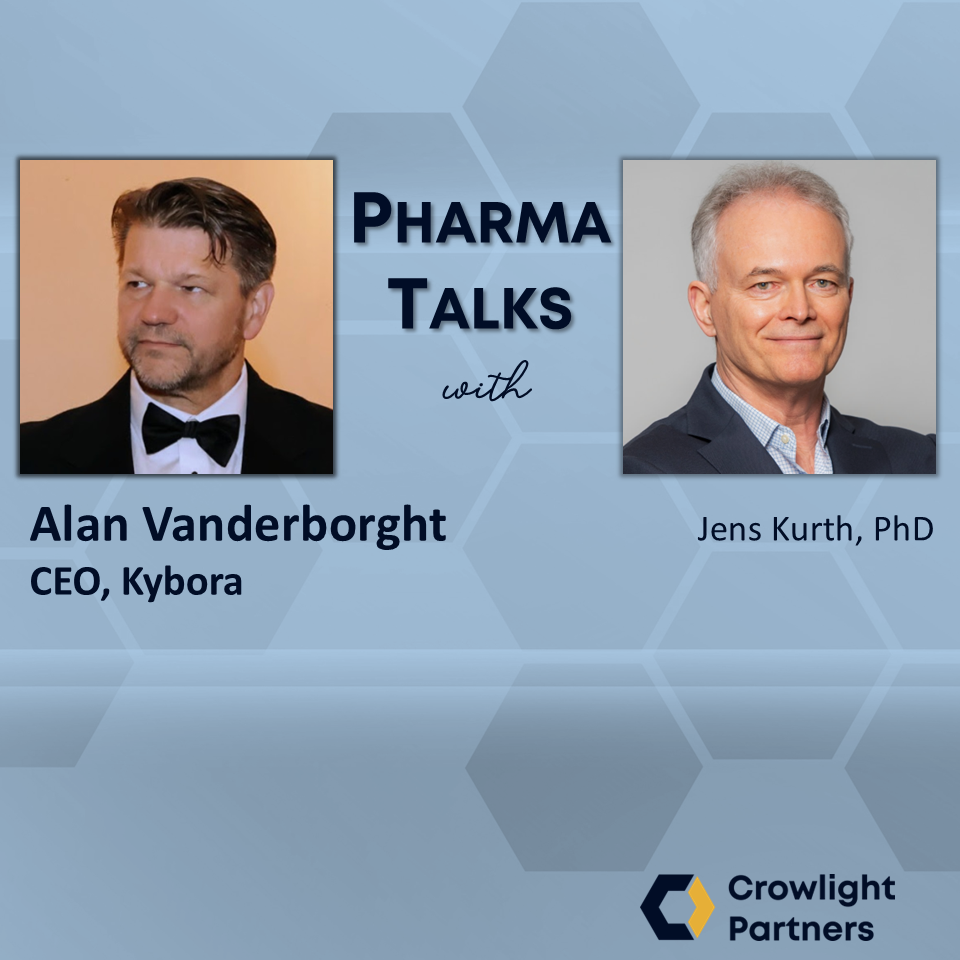
Alan Vanderborght is the founder and CEO of KYBORA, a global strategic advisory firm guiding biopharma companies through licensing, M&A, capital raises, and cross-border growth. With more than 25 years of experience and over 100 biotech transactions across five continents, he combines deep local market expertise with global deal-making execution. A multilingual entrepreneur with a background spanning consulting, finance, and international strategy, Alan is dedicated to helping transformative life sciences companies achieve enduring global success.
1. The M&A environment
Jens: How would you describe the current state of pharma and biotech M&A? Are we returning to pre-2022 dynamics, or has something fundamentally shifted?
Alan: The M&A landscape in biopharma is primarily driven by upcoming losses of exclusivity over the next five to ten years. Big pharma needs to replenish the top line because several important products are going away.
Valuations are also relatively favorable, which is why we’re seeing many bolt-on acquisitions. Buyers tend to focus on later-stage assets, either commercial products or programs with established proof of concept, so they can get to market fairly quickly.
There is also a focus on platform technologies: either because a product can expand into multiple indications, or because the underlying technology can be applied across other parts of the business.
Overall, there’s renewed interest in the sector, and that’s part of why sentiment has improved. However, biotech still faces fundamentals it hasn’t solved: the cost of developing drugs hasn’t improved in years, timelines remain long, and risk hasn’t diminished. At the same time, price control pressures are increasing, and competition from China has not been fully addressed, particularly in the U.S., and to some extent in Europe as well. So yes, there is breathing room due to M&A activity, but the industry should use this period to transform and become more efficient, so it comes out of this window on a stronger foundation.
Jens: I agree. Years ago, when I was co-founding biotech companies, platform technologies weren’t particularly attractive to investors, people focused on single drugs. That seems to have changed, and platform thinking is now also used to de-risk and broaden the opportunity.
Alan: Exactly. There’s a growing realization in large pharma that you need access to large markets. Obesity illustrates that. Look at the valuation multiple of Eli Lilly versus other big pharma, much higher, largely driven by the perceived long-term value of their obesity franchise.
That is pushing companies to prioritize very large opportunities. A product that will never exceed a billion dollars can be hard to justify in a very large organization. As a result, we expect consolidation in rare disease as big pharma exits. Consolidation in specialty pharma is also ongoing.
It will be interesting to see how biotech positions itself to be attractive to different pools of buyers.
2. What makes biotech attractive today
Jens: One major shift I see is evidence-based development: having a clear plan not only for the clinical trial, but also for biomarkers, endpoints, and early payer discussions, so pharma sees lower risk in licensing or acquiring. Ten years ago, many of us weren’t thinking about payers early.
Alan: I agree. One hope I have is that we reach the end of what I call the “biotech mafia”, financial engineering around products or platforms that are overly complex for the public to evaluate, where IPOs were used as a proof point for early exit, leaving less sophisticated investors holding the risk.
Greater access to information may reduce that. The IPO window still hasn’t truly reopened, and we probably need additional interest rate cuts before it does. But with more transparency, capital allocation should improve, though we’ll see.
3. Acquisition logic: diligence, CMC, and market reality
Jens: Today, does the “whole package” matter more, CMC readiness, clinical development quality, strong proof of concept? Has acquisition logic changed compared with 20 years ago?
Alan: These have always been the basic building blocks. If you’re spending hundreds of millions, or even ten million, you should do thorough due diligence to understand risk across all dimensions.
Yet deals still happen under urgency where diligence is limited, and that often comes back to hurt the buyer. We’ve seen situations where buyers paid extremely high multiples and later realized the assets couldn’t be leveraged the way they expected. Those are failures of decision-making and diligence.
Also, especially on the investment side, understanding the ultimate market has become far more important. The earlier you understand payer reality, the better your decision-making becomes.
The old assumption, “if the science is good, someone will figure out how to sell it”, is changing. Commercial practices have tightened. Products must demonstrate meaningful value to patients, and payers need to agree.
Still, we regularly see investments where this market work hasn’t been done. Teams focus on “what’s the next clinical trial” instead of asking: what will competitiveness look like in five or ten years? Who else is coming? What alternative mechanisms or technologies could challenge this? What are payers thinking? Unfortunately, this isn’t systematic enough.
4. Acquisition vs. interest
Jens: What triggers serious acquisition or partnering interest today? What makes a company “deal-ready”?
Alan: It starts with strategy. If you have a clear strategy, you understand what growth you need, at what pace, and whether you need inorganic options versus internal build.
Then there are events you can’t foresee, like a Phase III failure, that suddenly force action. A company may need to acquire or license a stopgap to stabilize while conditions change. That remains a key driver.
The competitive landscape matters on both the buy side and the sell side. Companies ask whether they can realistically be among the top three in an area. If they can’t, it may no longer make sense to keep investing, and divestment becomes the rational move.
For example, we’re working with a company that developed a platform and initially pursued immunology assets, but realized the platform has greater potential in metabolic disease. They refocused resources toward metabolic development and are now selling a portfolio of five early-stage immunology assets, interesting assets, just not strategic for them.
There are also cases driven by external pressure. If investors push for improved profitability or margins, companies may divest lower-margin businesses to improve overall economics and, by extension, valuation multiples.
So it’s a combination of long-term shareholder value creation, strategic discipline, and not missing emerging hyper-growth opportunities. A strong example is Eli Lilly’s GLP-1 strategy: many assume it “just happened,” but leadership has described having a clear strategy in 2017. That kind of foresight is impressive.
5. Why deals stall or fail
Jens: Why do some deals stall or fail, and how can leaders overcome those issues?
Alan: Most often, deals fail due to lack of alignment at the decision-maker level. A mentor once told me: “You’re the conductor on the train, make sure nobody gets off.” That’s accurate. Deals can derail easily.
It’s always easier to say “no” than to say “how do we make this work?” You want people who focus on making the deal work in a way that creates value for both organizations.
Alignment among decision-makers on both sides is critical. You need access to the real decision-makers and confidence that your counterpart truly has their ear. You need active communication back and forth, and ideally you become allies, each working internally to keep your respective organizations aligned. Many deals fail because that alignment work doesn’t happen.
6. Global perspective
Jens: Do you observe differences in how U.S., European, and Asian companies approach M&A valuation and risk? What should CEOs adapt when engaging across regions, especially given China’s competitiveness?
Alan: Culture is very different, and you have to be aware of that.
In Asia, deals typically start with the relationship. You build trust first, and then you do the deal.
In the U.S., it’s often more transactional: you can go straight to the terms and the numbers. You don’t need to be friends to do business.
That affects meeting dynamics. A hard-charging American style can create distrust in Asia if the relationship foundation isn’t there yet. Trust needs to be built.
On risk: in general, Americans are less risk-averse, sometimes because leaders in public companies may only have a three-to-five-year window in their role and want to show impact, transactions included.
Many Asian companies, often family-owned or operating with multi-generational horizons, and to some extent Europe as well, think longer-term. They are more cautious because decisions affect long-term sustainability and, in some cases, future generations.
The downside is that greater caution can mean missing opportunities. It’s the classic trade-off: high risk, high reward.
7. Deal readiness for 2026
Jens: What recommendations would you give CEOs preparing for M&A readiness in 2026? Where should they invest time and resources early?
Alan: The fundamentals are the same: clear data, a well-run operation, and clean financials.
In every deal, there is usually a “skeleton in the closet” somewhere. The key is to surface it, not hide it – and have a mitigation plan. Show the potential acquirer you understand the issue and are actively managing it.
Valuation sophistication is increasing. With scenario tools, including AI-based approaches, you should have a strong understanding of what your company is worth and why.
Clarity of purpose also matters. If you decide to sell, be decisive. Not “we’re exploring,” but: we’ve done the work, we know our value, we know where it comes from, we have a timeline, and we are executing. That gives buyers confidence their resources won’t be wasted.
Finally, be collaborative and transparent. Your fiduciary responsibility is to maximize value, but you do that by being clear about your model and assumptions, not by hiding or embellishing. You are who you are as an organization.
The best way to maximize value is to attract multiple credible parties and create competition. Transparency helps build buyer confidence and broadens the pool. To use an analogy: if you sell a house and show everything openly, more people can get comfortable, and you create competition. Too often companies hide issues, end up with only one buyer, and then fail to maximize value.
8. What will shape the next wave of pharma M&A
Jens: Final question: what scientific fields or business models will shape the next wave of pharma M&A?
Alan: AI will drive a lot of transformation. We started this conversation with the need for biotech to become more efficient. AI has the potential to streamline multiple verticals, discovery, manufacturing, regulatory, and clinical, so the process of bringing a drug to market becomes faster and less costly.
Historically, timelines expanded dramatically. There was a time when companies could bring drugs to market far faster than today. While safety and regulatory standards have evolved, we now finally have technologies that could compress timelines and reduce cost.
That enables new business models. If time-to-market and cost-to-market decline, pricing logic may evolve as well. AI can also support greater precision, targeting specific genotypes or subpopulations rather than broad, less efficient approaches.
Today there are roughly 2,000 pharmaceutical products targeting a few hundred mechanisms of action. There is heavy concentration around known biology, intense competition, and significant waste, especially when you’re not among the top three in a category. Over time, AI could help reduce redundancy and improve capital allocation.
This will take time – likely ten to fifteen years – but it’s coming.
Beyond AI, prevention could become more important. Pharma is largely treatment-oriented today; a more prophylactic model could grow.
Finally, global commercialization and collaboration are important. The current system, every country having its own regulatory agency, creates artificial silos and inefficiencies. Greater harmonization would be beneficial.
Jens: Thank you for your time and input.