



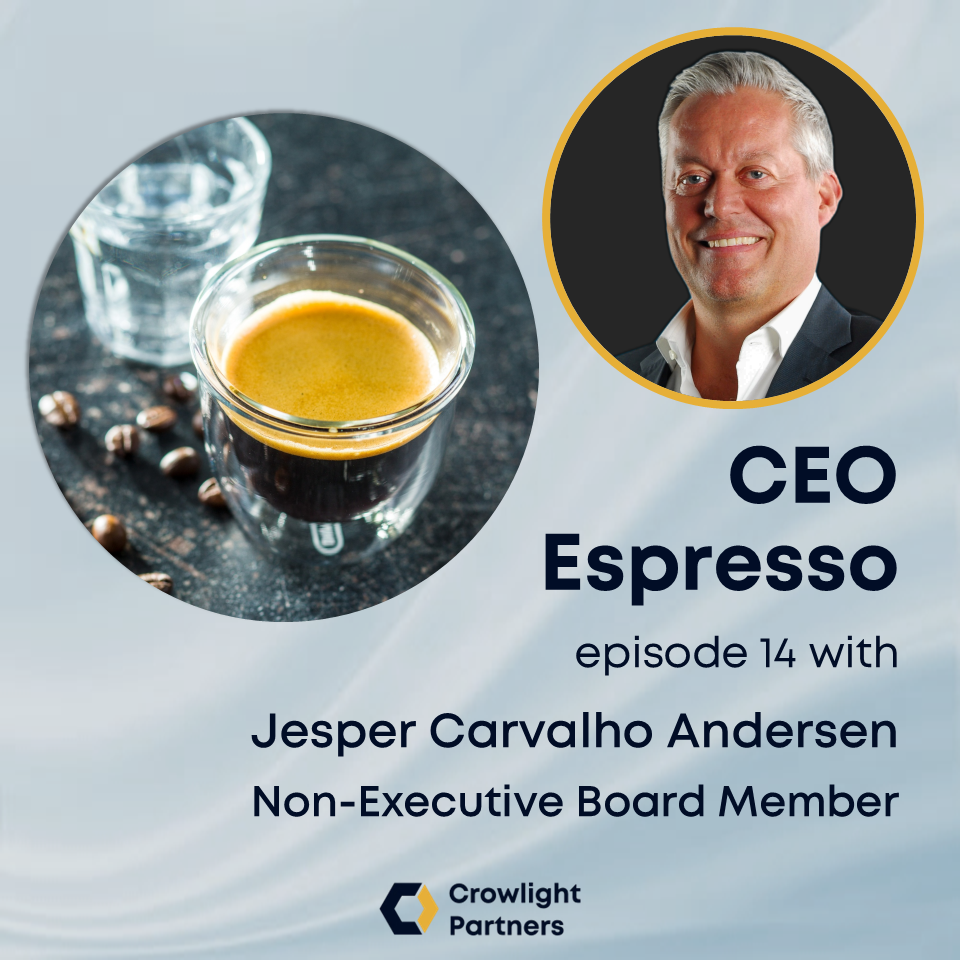
Jesper Carvalho Andersen is a Danish executive with over three decades of operating experience across eight European countries and 15 sectors, ranging from premium retail and private aviation to medical devices and longevity products. Since stepping out of executive roles after the Minisom exit, he has built a non-executive portfolio across areas he is passionate about: health and longevity, alternative financial assets, renewable energy, and the cultural sector. He chairs Nordic Health Group, the EU’s leading private vein surgery group. He speaks eight languages and lives outside Lisbon.
Question: What is the key to your success as a leader?
Two things, and they work together. The first is what I would call being a cultural bridge builder. I speak eight languages, not all at the same level, but whenever I went into a turnaround, I learned the language. In Italy, people thought I was from northern Italy. In Germany, they thought I was from Hamburg. That ability to meet people in their own context opened doors that would otherwise have stayed shut.
The second is tenacity. When you are a turnaround manager, the pressure is relentless and runs in both directions: the people you have inherited think you are moving too fast, and the people who hired you think you are moving too slow. You must hold your own conviction in that environment, over a sustained period. That is not something you learn in school. For me it comes from sport.
Together those two things make me a communicator people believe. Not because I am persuasive in the rhetorical sense, but because they can see that I believe it myself.
How did you structure your approach when you first arrived at a company?
I first worked very tightly with 100-day plans. Within 100 days I would be certain what needed to happen to make the company succeed, down to the detail of whether this person was on board, whether this product was the right one, whether this was the right direction. The timing might still be open, but the essence was clear.
And a turnaround always comes down to three things: financial re-engineering, some form of digital growth (in the 1990s that meant email, today it means something else entirely), and cultural development. Of those three, the cultural piece was always my real exit ticket. If I could build a sustainable culture that functioned without me, I could leave. If I could not, I might be able to make things run, but they would run on me. That is not an exit, that is a trap.
What did you look for in the existing team when you arrived?
Two things: capacity and attitude. Capacity meaning whether someone had what it takes to carry the responsibility of where the business needed to go. Attitude meaning whether they were genuinely committed to getting there. Everything else you can build on. In a turnaround you do not have time, and you may not have money either, but you always have even less time.
Was there a moment where the pressure was particularly acute?
The private jet situation in 2008. I joined a Scandinavian private aviation group in July as CEO, and we had just finished the 100-day plan when the financial crisis hit in October. Aircraft fleet values fell sharply across the sector and demand collapsed overnight. There are moments in this kind of work where the external environment changes underneath you, and there is nothing you can do except figure out what the new reality is and move.
How has your leadership style changed over the years?
Immensely. The world changed and I changed with it. The shift that mattered most for me, somewhere in the middle of my career as a turnaround manager, was realising what actually drove me. It was not the turnaround itself. It was not the money. It was team building. Watching the people immediately around me grow was what gave me energy and satisfaction.
Once I understood that, I redesigned everything. The skill I had brought from turnaround work, the ability to build a culture that does not depend on the person at the top, turns out to be exactly what you need as a non-executive supporting a management team through rapid growth.
What was the transition like into board work?
The transition took longer than I expected, around 12 years to complete fully. Building from a healthy position requires a different mental model from a turnaround, where you start from loss and work forward. The pace, the hiring decisions, the choice of which markets to enter, all of it must be self-sustaining. You cannot force it. It has to be natural.
How would you describe the relationsihp between your work life and personal life?
They are fully integrated, not as a compromise but as a conscious design. I use the same management principles in my personal life that I use professionally. “Bad news first” is not a work habit for me, it is how I communicate, including with my children.
I am quite allergic to the idea that a CEO plays a role. You adjust your register to your audience, you speak differently in a boardroom than at a football match, but the core is the same. What I am proudest of, honestly, is that through 32 home moves, through eight countries, and 25 years of turnaround work, I have kept a happy marriage of over 30 years and raised two children who found their own way.
What is the major achievement you still want to accomplish?
I designed my career in two halves. The first 25 years as an executive general manager. The second 25 years as a non-executive, working with my passions. I am in that second half now. What I am most looking forward to is the long arc of board work in sectors I care about, where the right governance over time can build something that lasts.
We conducted the interview in June 2026.