



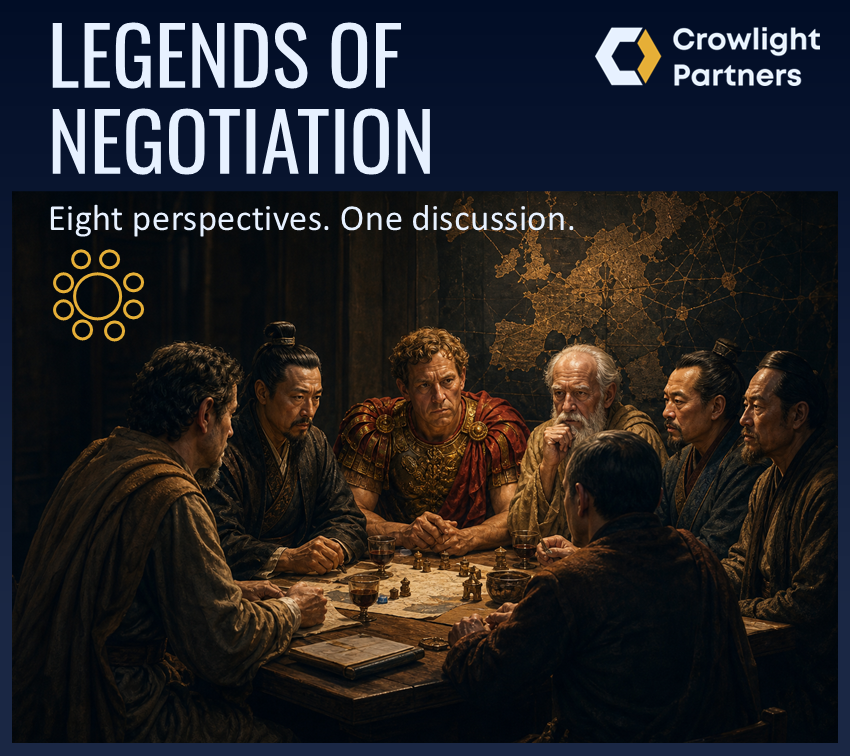
What if the greatest minds in history sat down together at the same negotiating table?
And what if they disagreed?
Even better.
So let us imagine a conference room somewhere between the centuries.
Eight men sit around a table. Masters of negotiation.
Who are they? And what defines each of them?
Confucius (c. 551–479 BC, State of Lu, present-day Shandong Province, China) focuses on relationships.
Augustus (63 BC–14 AD, Rome, Italy) sees power as the central factor.
Thomas More (1478–1535, London, England) considers himself a humanist.
Sun Tzu (probably c. 544–496 BC, State of Qi, China) prepares meticulously. He has already analysed the room before entering it.
Benjamin Franklin (1706–1790, Boston, Massachusetts, USA) thinks in terms of coalitions. He knows everyone at the table—and is already working on persuading two of them to join forces.
Maimonides (1138–1204, Córdoba, Al-Andalus, present-day Spain) thinks in terms of integrity.
Niccolò Machiavelli (1469–1527, Florence, Italy) is concerned first and foremost with his own interests.
And Socrates (c. 470–399 BC, Athens, Greece) believes that most people are simply asking the wrong questions.
“What is a good negotiation?” he asks the group.
Machiavelli answers immediately.
“One that you win.”
Confucius shakes his head.
“One after which people still want to work together.”
Augustus smiles.
“One after which the balance of power is more favourable than before.”
Franklin reaches for the wine.
An evening like this requires preparation.
Sun Tzu says nothing.
He observes.
That alone makes him the most dangerous person in the room.
“Interesting,” says Socrates. “Different answers. No definition.”
Machiavelli writes something down.
Probably weaknesses.
Possibly names.
Nobody asks.
In complex negotiations, we encounter the same mistake again and again: people believe they are discussing prices, contracts, or deadlines.
In reality, they are pursuing entirely different objectives.
For one person, speed matters most.
For another, control.
For a third, the relationship.
For a fourth, the outcome.
Those who fail to recognise these different definitions of success end up negotiating symptoms rather than interests.
“Perhaps,” Socrates says after a long pause, “bad negotiations begin the moment everyone assumes they are talking about the same thing.”
For the first time, the room falls silent.
Even Machiavelli looks up.
Over the coming weeks, these eight men will debate power, trust, information, pressure, coalitions, and integrity.
They will rarely agree.
And that is precisely why they are worth listening to.
Which of these characters would you most want on your side of the table?