



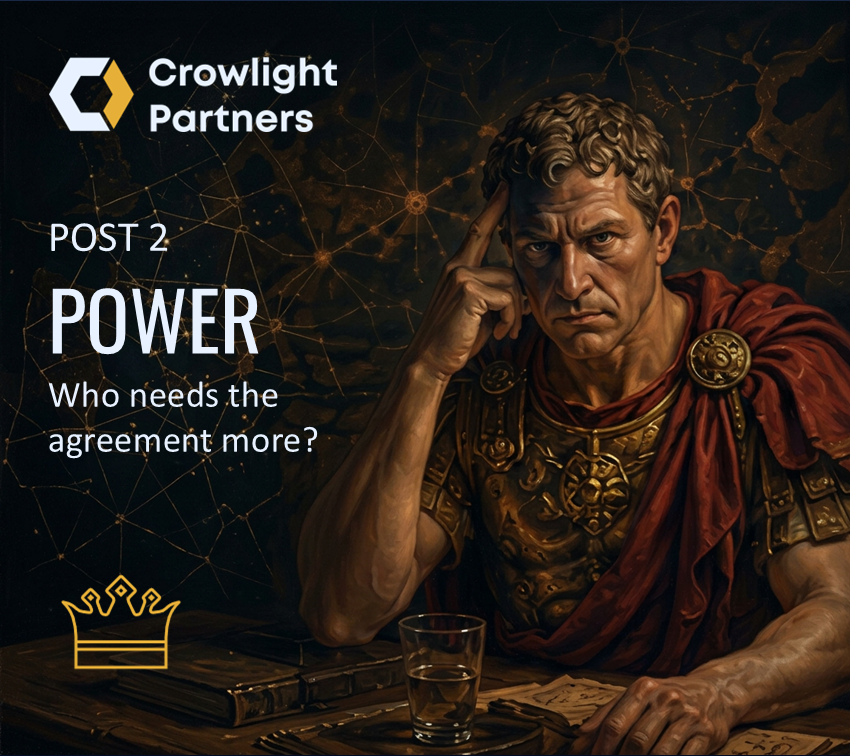
⚖️ People like to talk about fairness.
Especially when the balance of power is not in their favour.
Augustus does not say this out loud.
You can tell he is thinking it.
The discussion begins harmlessly enough.
Confucius speaks about respect. Trust. Legitimacy.
Then Augustus leans back.
“You keep talking about how people want to be treated. Why is nobody talking about why they listen in the first place?”
Franklin sets down his glass.
That is rarely a good sign.
“Because power without legitimacy is unstable,” Confucius replies.
Augustus nods.
“True.”
A brief pause.
“And legitimacy without power?”
An even shorter pause.
“Irrelevant.”
Maimonides disapproves of the remark.
Machiavelli likes it very much.
The truth is uncomfortable:
Most negotiations are not decided by the better argument.
They are decided by the better alternative.
Those who have time negotiate differently.
Those who have options negotiate differently.
Those who do not need to reach a deal negotiate differently.
That is why professional negotiation preparation rarely begins with arguments.
It begins with a question:
Who needs the agreement more?
“The American Revolution was not won because the colonies were right,” Machiavelli interjects.
Franklin raises an eyebrow.
“Then why?”
“Because at some point they had more options than the Crown.”
Franklin remains silent.
That is noteworthy.
In complex negotiations, power is often judged in moral terms.
That is understandable.
It is rarely helpful.
Power is neither a virtue nor a flaw.
It is a variable.
Those who ignore it do not understand the negotiation.
Socrates looks around the table.
“An interesting discussion. But how does each of you recognise your own power?”
No one answers immediately.
Augustus would say: The strength of your negotiating position is determined by the quality of your alternatives.
Socrates would ask: And do you really know what your alternatives are?