



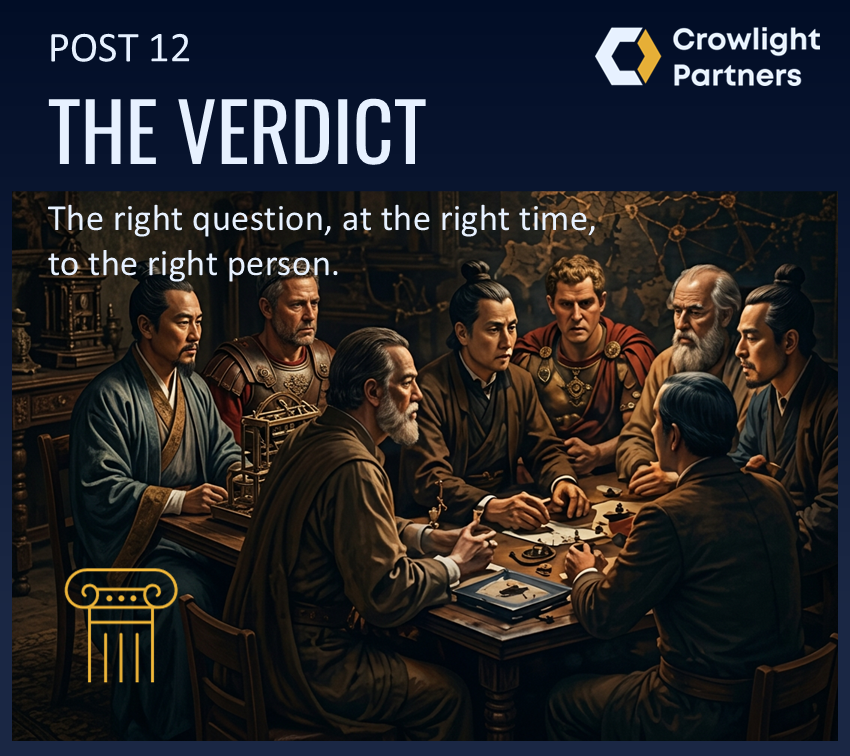
🏛️ Twelve evenings.
Twelve discussions.
No consensus.
Benjamin Franklin considers that a success.
Augustus considers it time spent.
Socrates considers it a beginning.
The wine is gone.
The notebooks are full.
“What have we learned?” asks Socrates.
Sun Tzu answers first.
As so often, unexpectedly.
“Most people underestimate preparation.”
Augustus adds:
“And overestimate arguments.”
Confucius:
“They underestimate relationships.”
Machiavelli:
“And ignore interests.”
Franklin:
“Furthermore, they regularly forget the people who are not even at the table.”
Maimonides nods.
“And some believe success is a justification.”
Thomas More, who has been silent until now, puts down his pen.
“And some,” he says calmly, “confuse strength with the absence of boundaries.”
Machiavelli looks at him.
Says nothing.
Writes something down.
For the first time on this final evening, no one disagrees.
The discussions have revealed something interesting:
Negotiations are not a communication task.
At least not only.
They are decisions under uncertainty.
They combine:
Power and legitimacy.
Interests and relationships.
Speed and patience.
Information and interpretation.
Those who see negotiations exclusively as a power game see too little.
Those who see them exclusively as a relationship exercise do as well.
The best negotiators move between different mental models.
Depending on the situation.
Depending on the counterpart.
Depending on what is at stake.
Socrates stands up.
As the only one, he does not reach for his notes.
“So the answer is: it depends?”
Augustus closes his eyes.
Machiavelli visibly rolls his.
Franklin casually orders another bottle of wine.
Sun Tzu smiles—for the first and only time that evening.
Socrates looks around the table.
“I have learned nothing tonight.”
A pause.
“I only have better questions.”
He leaves.
As always, barefoot.
And perhaps that is the true art of great negotiation:
Not knowing the perfect answer.
But asking the right questions.
At the right time.
To the right person.