



PCB & Semiconductors
Glass fabric, copper foil, laminate and printed circuit boards are being allocated. Which customers are still being taken into account, and to what extent, depends on size, forecast quality and strategic priority, and on the agreements already in place.
We work with OEMs, Tier 1 suppliers, EMS providers and PCB manufacturers so that they can protect their margins, keep their supply secure and limit their exposure in a market under allocation.
A sellers’ market that will not turn quickly
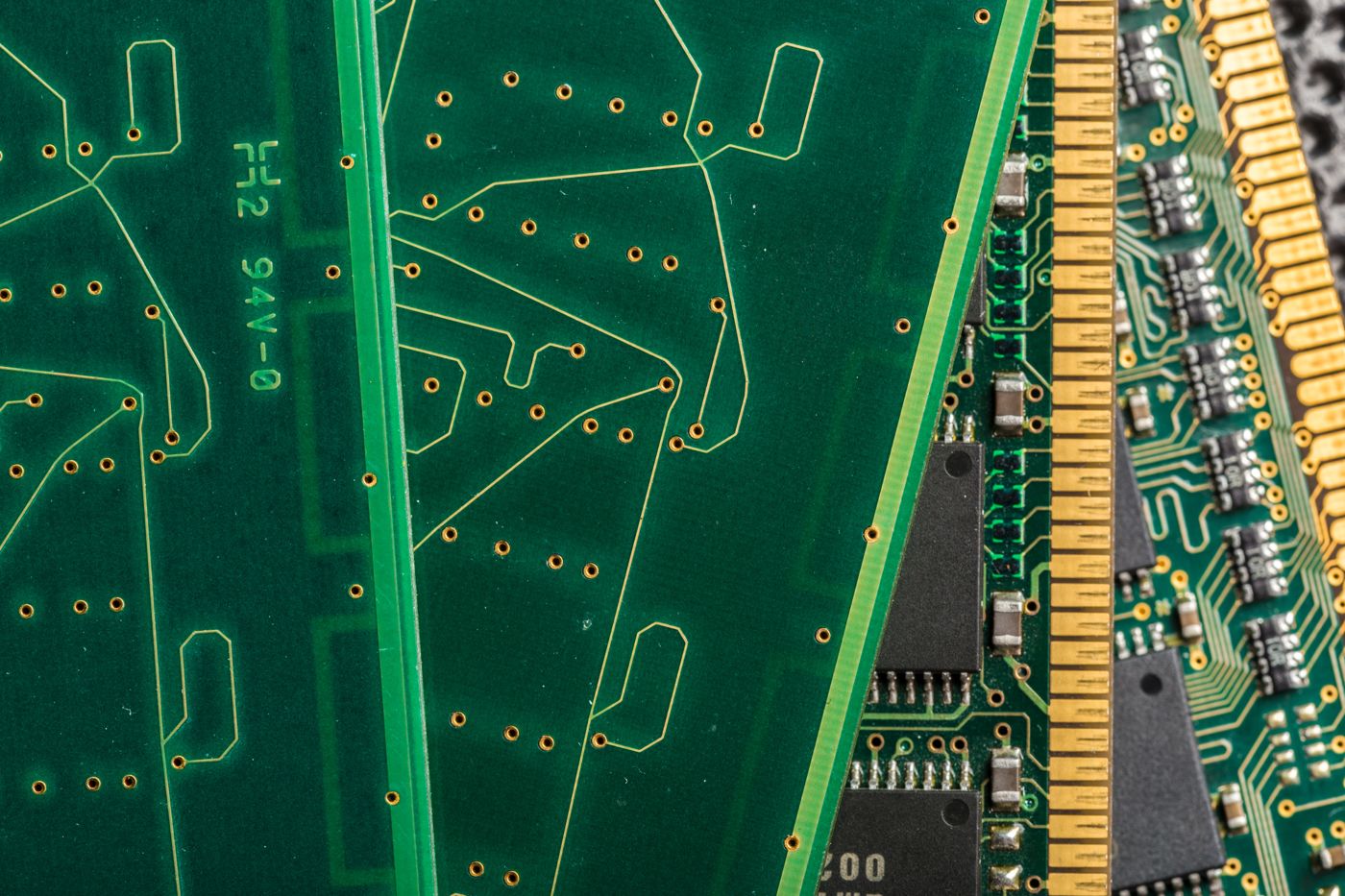
AI servers can require five to seven times more laminate than conventional servers. New capacity follows slowly: expanding laminate production takes 18 to 36 months of ramp-up, and high-end glass fabric comes from a small number of suppliers. Laminate makers are shifting capacity to the high-end materials these servers need, and capacity for standard FR-4 shrinks as a result. Some PCB manufacturers no longer accept standard orders at all.
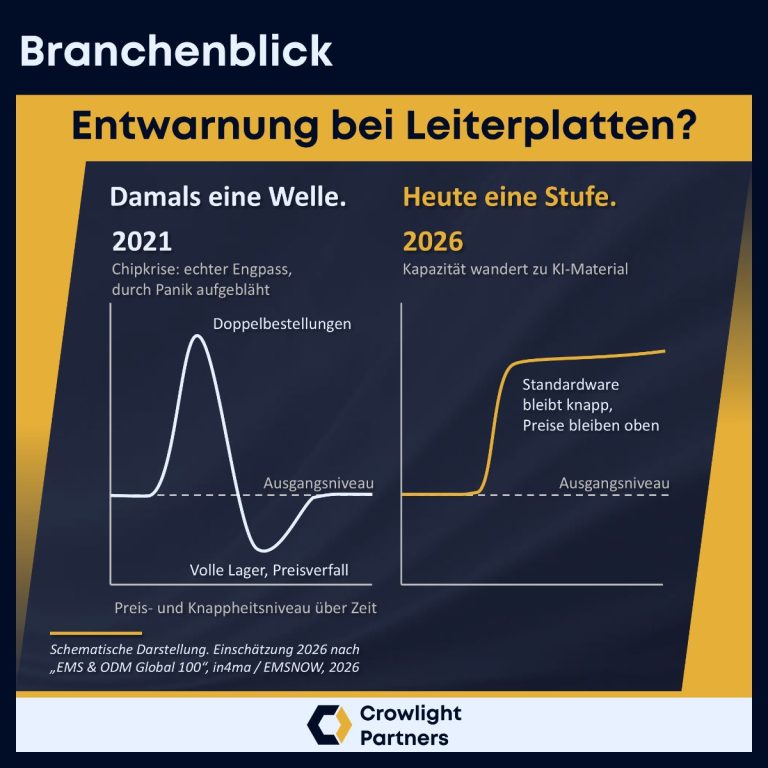
Unlike the chip crisis of 2021, this shortage is not driven by panic buying and double orders. It rests on structural demand and will not disappear with the next inventory correction.
Suppliers now decide who receives how much. Quantities are confirmed for weeks rather than months, and prices increasingly only at delivery. Customers with large volumes, reliable forecasts and long-term commitments are served first.
Prices have followed. Standard double-sided PCBs have risen by 40 to 60 percent, four-layer boards by about 100 percent, standard FR-4 laminate by 180 to 210 percent. Even the largest EMS providers earn average operating margins below four percent; increases of this size cannot be absorbed. Whoever cannot pass them on pays for them out of their own result.
Many buyers still negotiate as if nothing had changed: annual fixed prices, cost-down targets, call-offs on demand. In an allocation market, that logic makes them the customer served last. At the same time, visibility often ends at the direct supplier, while the bottleneck sits two or three tiers further down the chain.
Meanwhile, the market is splitting. A handful of large EMS and ODM groups capture most of the AI business and grow about four times faster than the rest. In Europe, around 2,300 EMS companies serve a market that 1,500 companies serve in the United States, and acquisitions are accelerating. For mid-sized companies, the question is no longer only how to secure supply, but where they want to stand in this market.
In semiconductors, the same questions arise in a political frame. Sovereignty, security of supply and public funding bring more parties to the table, and turn supply agreements into negotiations with interests beyond price.
Source: EMSNOW/in4ma, The EMS & ODM Global 100 Report, 2026.

What we hear from the industry
- The supplier confirms quantities only a few weeks ahead, and prices only at delivery.
- The largest customer still expects annual cost-down, while material costs keep rising.
- An index clause is on the table, but nobody has agreed which index, which trigger and which review date.
- Purchasing, engineering and sales each see part of the risk, and nobody has the mandate to decide.
- As a PCB manufacturer, you allocate scarce capacity yourself and need criteria your customers will accept.
- A long-standing supplier no longer quotes for standard boards, because better-paid orders fill its capacity.
- Material costs rise faster than your own prices, and your margin was thin to begin with.
PCB Resilience Check
Thirteen questions on your supply of PCBs and base materials. You see immediately where your company stands and which two levers to examine first. No registration, no e-mail address.
What we work on with you
We focus on the levers that can substantially improve your position. They vary with a company’s size, its competitive environment and its place in the value chain:
An EMS provider with thin margins, whose customers prescribe its PCB suppliers, will first look at who carries the price risk between quotation and order, and at what it can pass on.
An OEM that specifies only function and footprint has more room than it thinks. Approving alternative materials can be worth more than the next price round.
A Tier 1 supplier caught between rising purchase prices and fixed OEM prices needs a position on both sides before the next negotiation begins.
A PCB manufacturer that allocates scarce capacity itself holds a lever its customers rarely see, and needs rules for using it that those customers will accept.
Which levers matter depends on where you sit in the chain, on your capabilities, your liquidity, your customer structure and your supplier base. We work them out with you, from measures that take effect within weeks to changes in processes, organization and strategy. Instead of imposing a ready-made solution, we start from your figures, your contracts and your relationships.
Related topics: Price and terms negotiations · Rethinking the business strategy · Mergers and strategic partnerships
Recent posts on PCB and semiconductors


Let’s talk about your supply situation. 30 minutes with an experienced partner of Crowlight, not with a sales team.