



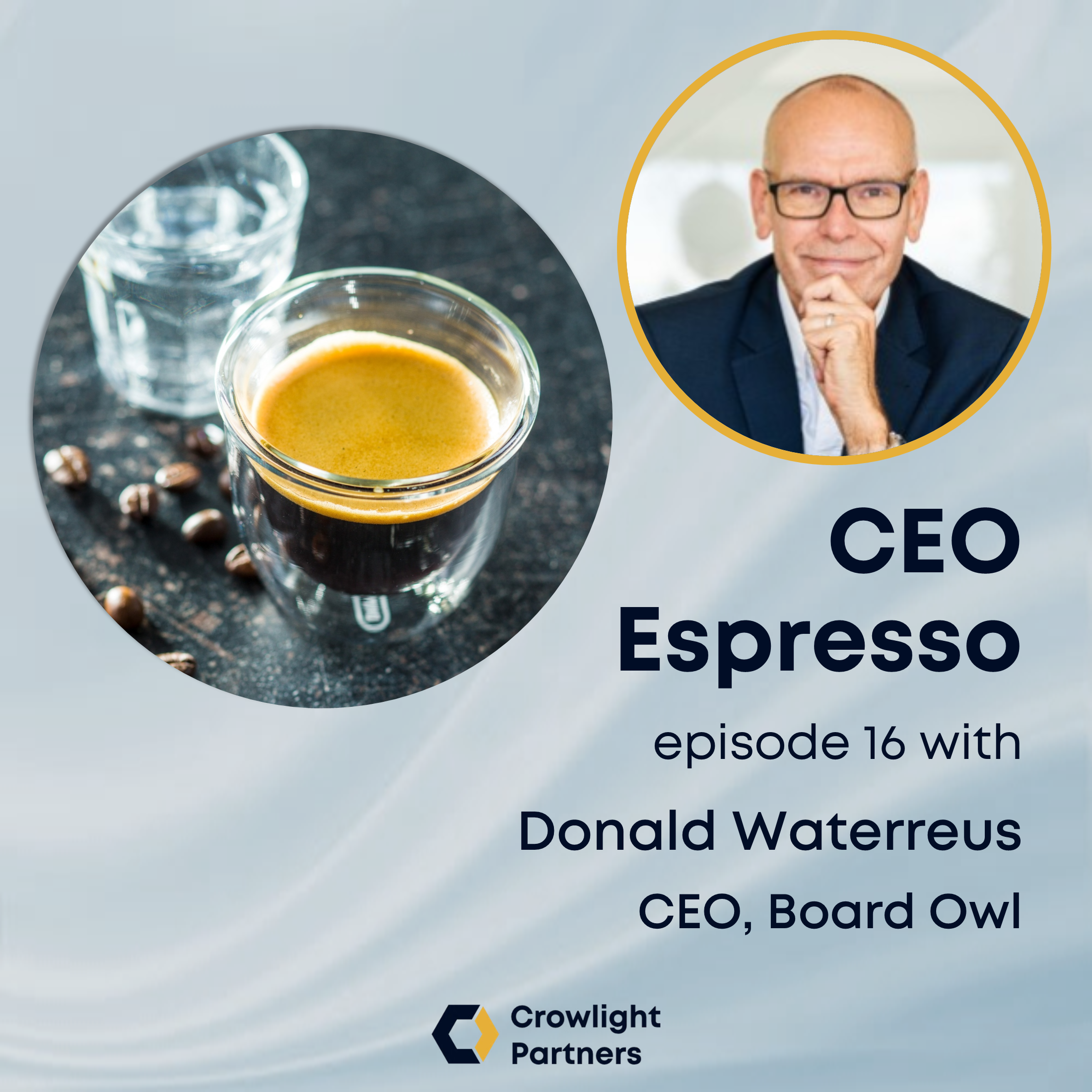
Donald Waterreus is CEO and co-founder of Board Owl, a Zurich-based training platform for board directors and supervisory board members. Before founding the company, he was Chief Operating Officer at Pictet Wealth Management in Geneva, and spent many years at UBS before that. In this conversation, he explains how an original matching idea for board candidates became today’s training programme, what makes the transition from executive to non-executive so difficult — and why a board biography is something different from a CV.
What made you decide, after your time as a bank COO, to found a company specifically in the board space?
At its core, it was pure self-interest in the subject. A longtime friend, a headhunter by profession, asked me a simple question over one of our regular coffee catch-ups: What do you actually want to do once this job is over?
I was in my mid-fifties and had already been through a few of those typical job cycles — phases where you’re entirely focused on the next challenge, on hurdles and deadlines — which can occasionally make you lose sight of the bigger picture. His question brought that bigger picture back into view. I knew I didn’t want another operational executive role. I wanted to build what’s now called a portfolio career — a mix of different activities, with board mandates being one of them.
Two criteria mattered to me: I wanted to only do things that genuinely excite me, and only work with people I enjoy being around. I called him the next day. We’d independently arrived at the same idea — and that’s how Board Owl came about.
Board Owl was originally meant to match companies and board candidates. How did the focus shift to training?
My co-founder had factored training into our business model from the start as its own revenue stream — a way to bridge periods when we had more candidates than open positions. I was skeptical at first, but he convinced me. It became our most profitable line of business.
What often plays into board appointments is whether you know someone and trust them. Unfortunately, trust sometimes beats competence. Either way, it held back our pure matching business.
We could have built Board Owl, with our candidate database, into a traditional executive search firm — but being just another recruiting boutique among many didn’t appeal to me. Of the three founders, I’m now the only one still actively involved — from skeptic to biggest beneficiary.
It’s no coincidence the owl – as a symbol of wisdom – gives the company its name …
Our tagline is “Matched with Wisdom” — Wisdom for the owl, Matched for the original platform idea. A branding consultant developed it with us, and it still fits today, even though the focus has shifted.
Tell me about the transition from executive to non-executive. What do most people underestimate — and what do they overestimate?
As an executive, you’re nose-in, hands-on. As a board member, you have to stay nose-in but go hands-off — and that’s exactly what most people underestimate. You spend three or four decades conditioned to believe that success means rolling up your sleeves, solving problems, hitting deadlines, delivering results — that’s precisely what gets you promoted. That conditioning doesn’t switch off overnight. For many executives, staying out of it entirely is a completely new discipline.
I’ve experienced this myself, on a fintech advisory board in Zurich: I was excited about the product, knew the right people — and caught myself starting to take meetings for the company. Even though this might have had a higher chance of success than letting the young founder do it, it’s not your job. A board member who takes over sales themselves is sitting in the management team’s chair.
On top of that, seniority and decades of experience lead many people to assume they don’t need any preparation. That’s where many overestimate themselves — believing their long experience automatically qualifies them.
So: what’s underestimated is that hands-off is a real challenge, because you’re conditioned differently. And what’s overestimated is that seniority automatically qualifies you for a non-executive role.
What you do with your participants sounds a lot like coaching.
It is. You can broadly distinguish between two types of managers: motivators and commanders. As a commander, you can get quite far in the corporate world. If you know what needs to be done and make it happen, you rise. But those are exactly the people who struggle more with the transition to non-executive roles. The motivator type — the people manager — tends to find it comparatively easier, because emotional intelligence matters almost more than IQ.
Who has it harder: introverts or extroverts?
In my own experience, extroverts get more airtime — they speak up faster, get heard sooner, and find it easier to make a strong first impression. But a good chair knows that, on a board, both types complement each other. Introversion and extroversion are their own dimension of diversity, alongside background, skillset, and so on.
A board made up entirely of the same type might reach consensus faster in discussions, but it’s blind in one eye. That’s why the chair has to make sure introverts get heard too: they tend to think before they speak rather than while speaking — and that often lets them spot a problem earlier. On a well-run, well-composed board, it ultimately doesn’t matter whether you’re introverted or extroverted.
What sets a board biography apart from a classic CV?
A CV is backward-looking — what have I achieved. A board biography has to be forward-looking: what can I mean for this company? In our training, we have participants write exactly that down, and nine out of ten start with the same generic sentence: “Senior executive with decades of international experience.” At any given moment, a hundred people are waiting for their tram on Zurich’s Paradeplatz, and eighty of them could write the exact same sentence about themselves. It’s true — but it makes nobody unique.
What matters is what someone, with their thirty years of experience, can mean for this specific company — forward-looking, not backward.
How does your power as a leader change when you move from executive into a board role?
As an executive, you have power over people: their careers, their pay, their next promotion — and people act on your word. As a board member, you no longer have that power. You’re not constantly present, you don’t decide on promotions or salaries, at most on appointing members of the executive team.
More than ever, you now have to back your competence by being convincing — not by issuing directives. That’s a central question for every aspiring non-executive: if you take away the power, what’s actually left of you? What can you deliver — without it?
What’s the value of negotiation skills for aspiring board members?
Not just aspiring ones — for every board member! It’s a core competency. It’s not about whether I’m right, it’s about whether I get my way. If I can push through ninety percent of my ideas and find a compromise on the remaining ten percent that brings the others along, that’s worth more than being right about everything — and ending up with nothing to show for it.
A diverse board inevitably brings more differing opinions, and therefore longer discussions. What matters then is the ability to say: while I don’t fully agree, if we do this together, we’ll get further — so I’ll meet you partway.
That’s a form of conflict management and facilitation I need when I have a well-diversified board. And I do want that productive friction, to arrive at better decisions and uncover blind spots. A like-minded board — “we meet, we agree, we vote, we go for lunch” — gives me no added value.
Which part of your work do you enjoy talking about most?
That has shifted over time. At first, it was simply about getting the idea known in the first place. We launched just before Covid hit, and suddenly sixty people were sitting in a webinar, simply glad to see another face. Today the training almost runs itself, and what I particularly enjoy now is the format: boutique training instead of lecture-style teaching. At university, fifty people sit in a lecture hall; with us, the group stays deliberately small so everyone genuinely gets a chance to speak — and if someone hasn’t said anything for half an hour, I ask them directly.
Often people say afterwards that it was actually too short — that’s the best feedback I could get. My own contribution is mostly just the enthusiasm I bring to it.
How would you describe the relationship between your professional and private life today?
Someone recently put it well: Career 3.0. The chance to stay intellectually active, to be valued for what you do, without sitting in one place from morning to evening — sometimes as an entrepreneur, sometimes as a board member, in different places — and still having time for the dog. I can set that balance myself today. It’s also no longer work-life balance in the classic sense — both are simply part of the same life.
Is there anything you’re personally working on right now?
Two things. Professionally, I’m following how expectations around AI competence are shifting. At some companies, not working with AI already counts against you in your annual review. Managers are even expected to embed it in their teams. I like to compare it to Excel thirty years ago: anyone still using a calculator back then was simply slower. That’s why, for instance, I’m currently listening to an audiobook on how to make good use of Anthropic’s Claude. It fascinates me enough that I’ve extended my dog walks just to finish a chapter.
Privately, I’ve taken up tennis again after fifty years and discovered it’s practically a different sport now — new equipment, new technique… My coach first had to get me to unlearn my old movement patterns before the new ones could take hold. Fundamentally the same process as the transition from executive to non-executive: you have to let go of something old before the new thing can work.
We conducted the interview in September 2026.